Live preview · Letter (8.5" × 11") · Gray lines
Isometric Dot Paper
Isometric dot paper arranges dots in triangles instead of squares. Join them along the three natural directions and you get cubes, prisms and stacked blocks that look three-dimensional, with every edge the same length on the page.
Download saves a vector PDF in the size and color selected below, no print dialog needed.
Other formats:
Direct PDF:Isometric Dot Paper Letter PDFIsometric Dot Paper A4 PDF
Choose a different paper size:
Choose a different line color:
Great for
- Drawing cubes and block structures in math class
- Isometric sketches for design and technology
- Pixel-style isometric game art
- Tessellations and triangle or hexagon patterns
Isometric Dot Paper at a glance
| What it is | Dots on a triangular lattice for drawing cubes, 3D shapes and isometric views. |
|---|---|
| Category | Dot Grid |
| Paper sizes | Letter (8.5" × 11"), A4 (210 × 297 mm), A5 (148 × 210 mm), Half Letter (5.5" × 8.5"), B5 (176 × 250 mm), Legal (8.5" × 14"), 11" × 17", A3 (297 × 420 mm), A2 (420 × 594 mm), Poster (18" × 24"), Movie Poster (27" × 40"), Letter Landscape (11" × 8.5"), A4 Landscape (297 × 210 mm), Tabloid Landscape (17" × 11") |
| Line colors | Faint, Light, Gray, Dark, Black, Blue, Green (default: Gray) |
| Format | Vector PDF at exact physical scale (Letter PDF, A4 PDF), PNG or SVG, or print directly from the browser |
| Price & license | Free. No signup or watermark. Printed sheets may be used for personal, classroom and commercial work. |
About isometric dot paper
An isometric drawing shows an object tilted so that its three axes appear 120 degrees apart and equal lengths along any axis are drawn equal. Isometric dot paper supplies the guide points for that view: the dots form equilateral triangles, so the three directions you need are always available between neighbouring dots. Schools use it for volume and surface area work, where students draw solids built from unit cubes and count the cubes they can and cannot see. It gives the same geometry as lined isometric graph paper but leaves the page nearly empty, so the finished drawing is not competing with a mesh of printed lines.
What's on the page
Dots 0.7 mm across on a triangular lattice. Each dot has six neighbours exactly 5 mm away. Columns of dots are about 4.33 mm apart (5 mm × √3 / 2) and every second column is shifted down by 2.5 mm. On US Letter that gives 45 columns with 51 or 52 dots each. The vertical direction runs up the page, which is the orientation used for standard isometric drawings with vertical edges.
How to use it well
Start with one cube
Draw a vertical edge of two dots, then from its top go up-right and up-left by the same count, and close the shape. Once one cube looks right, every other solid is built from the same three directions.
Keep verticals vertical
Vertical edges of the object follow the columns of dots. The other two axes slope 30 degrees up to the left and right. If an edge does not follow one of those three directions it is not parallel to an axis of the object.
Shade by face direction
Give all top faces one tone, all left faces a second and all right faces a third. Consistent shading is what makes a stack of cubes read as solid.
Draw in pencil, ink the visible edges
Sketch every cube lightly first, then ink only the edges you could see from the viewing angle. Hidden edges can be erased or dashed.
Common mistakes to avoid
- Turning the page sideways. With the sheet rotated a quarter turn the lattice has horizontal rows but no vertical columns, so cubes come out lying on a corner.
- Trying to measure true diagonals. Isometric drawings are only to scale along the three axes. A line that crosses a face diagonally is not drawn at the same scale.
- Using it for ordinary graphs or notes. The dots do not form squares, so tables, axes and text will not line up. Use a square dot grid for those.
FAQ, Isometric Dot Paper
What is isometric dot paper used for?+
Drawing three-dimensional objects in isometric view: cubes, stacks of unit cubes for volume problems, prisms, simple buildings, and design sketches.
What is the difference between isometric dot paper and isometric graph paper?+
The geometry is identical. Isometric graph paper draws the three sets of lines; isometric dot paper prints only the points where they cross, which leaves a cleaner drawing.
How far apart are the dots?+
Every dot is exactly 5 mm from each of its six nearest neighbours when printed at 100 percent scale.
How do I draw a cube on it?+
Pick a dot as the nearest bottom corner. Go up one or more dots for the vertical edge, then draw equal-length edges up-left and up-right from both ends of it, and join the top with two more edges to form a diamond-shaped top face.
Can I use it for hexagon patterns?+
Yes. Any dot together with its six neighbours forms a regular hexagon, so the paper works for hexagonal tilings and tessellations.
Printing tips for best results+
- 1. Click Print above. A new tab opens the template at exact size.
- 2. The print dialog appears automatically. Set Scale to 100%. Never "Fit to page", which silently shrinks every cell.
- 3. Set Margins to None or Minimum so the grid reaches the page edge.
- 4. For a PDF, click Download instead. It generates a vector PDF directly without going through the printer driver.
More detail in the guide to printing graph paper at actual size. Need a spacing that isn’t listed? Use the graph paper generator.
You might also like

Dot GridPopular
Dot Grid Paper (5mm)
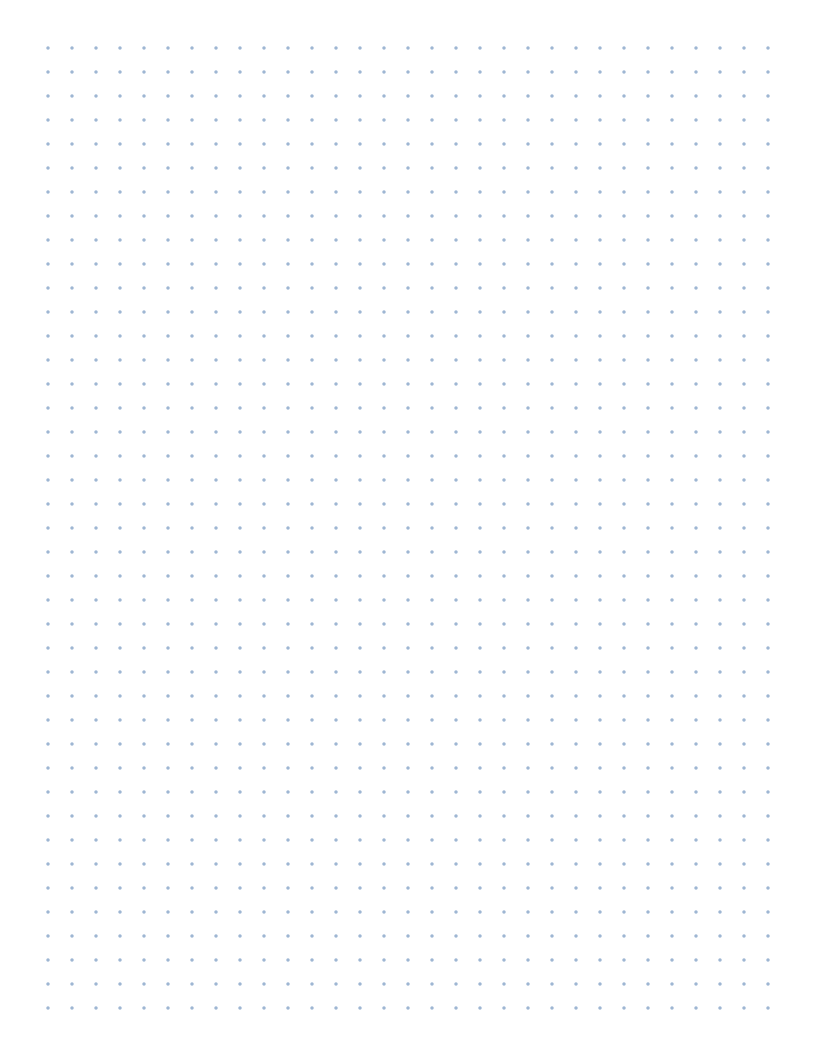
Subtle 5mm dot grid: the gold standard for bullet journals and clean sketches.
Dot Grid
Dot Grid Paper (1/4")
Quarter-inch dot grid: bullet journal layout matched to US paper.

Dot Grid
Dot Grid Paper (7mm)
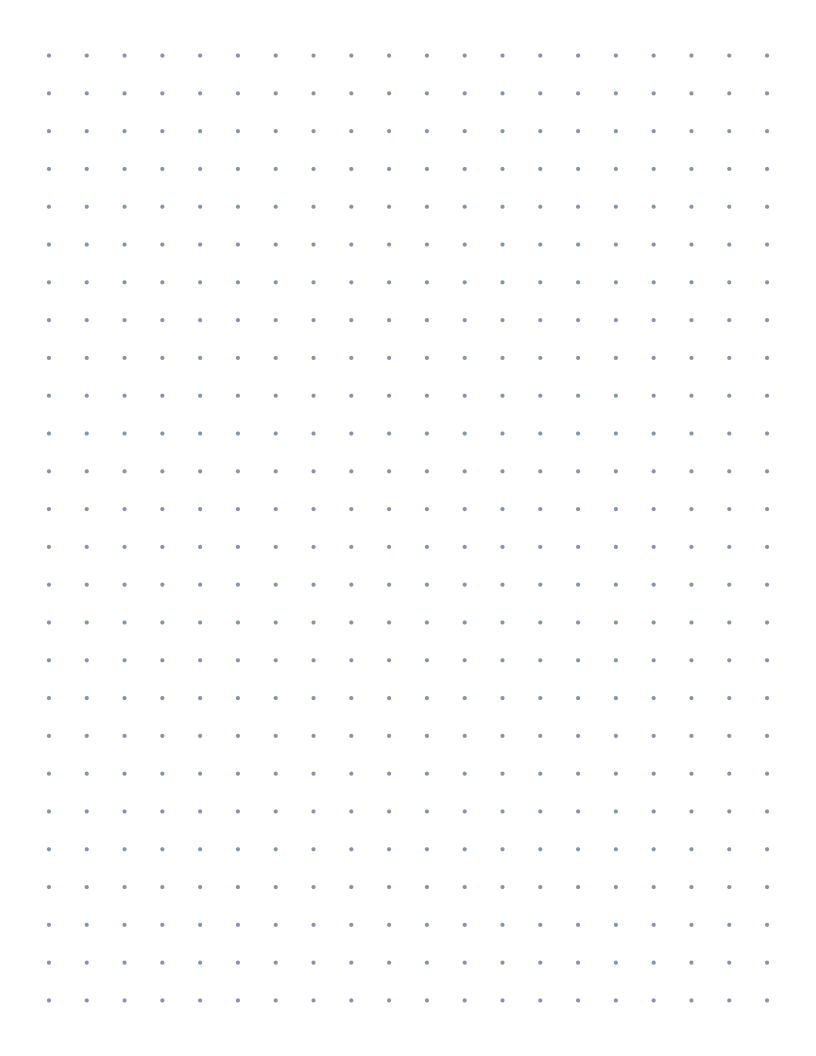
Roomy 7mm dot grid for larger handwriting, lettering practice and planner layouts.
Dot Grid
Dot Grid Paper (1cm)
1 centimeter dot paper for classroom geometry, geoboard work and area and perimeter exercises.