Live preview · Letter (8.5" × 11") · Gray lines
1/4 Inch Graph Paper
Quad ruled paper has four squares per inch, 6.35 mm per cell, which is the size US schoolchildren and engineers grew up writing on. If you went through American education and remember a composition book grid, this is it.
Download generates a crisp vector PDF directly, no print dialog needed.
Choose a different paper size:
Choose a different line color:
Great for
- Math worksheets and homework
- Engineering coursework and drafting
- Lab notebooks and field logbooks
- Graphing functions and data
1/4 Inch Graph Paper at a glance
| What it is | Classic four-squares-per-inch quad ruled paper: the US engineering standard. |
|---|---|
| Category | Grid Paper |
| Paper sizes | Letter (8.5" × 11"), A4 (210 × 297 mm), 11" × 17", Legal (8.5" × 14"), A3 (297 × 420 mm), A2 (420 × 594 mm), Poster (18" × 24"), Movie Poster (27" × 40") |
| Line colors | Faint, Light, Gray, Dark, Black, Blue, Green (default: Gray) |
| Format | Vector PDF download at exact physical scale, or print directly from the browser |
| Price & license | Free. No signup or watermark. Printed sheets may be used for personal, classroom and commercial work. |
About 1/4 inch graph paper
Quad ruled paper was the default of US technical education for most of the 20th century. The choice of four squares per inch isn't accidental: it lines up with the imperial measurement system at every level. 1/4 inch per cell, 1 inch every four cells, 12 inches every 48. That meant a draftsman could convert pencil sketches to scaled drawings without ever leaving inch fractions, and a lab tech could plot pressure readings at 'one cell per 0.25 psi' without doing mental conversion. The metric world standardised on 5 mm; the imperial world on 1/4 inch. They look almost identical at arm's length, but the 27 % size difference is enough that grids made for one don't overlay onto the other.
What's on the page
A uniform grid of 1/4 inch (6.35 mm) squares, hairline-weight (0.15 mm), with no accent lines. Cells are equal-weight throughout, matching the look of a US composition book. On Letter paper you get about 30 × 40 full cells; on Legal, 30 × 52. Grid lines run cleanly to the edge so you can count cells outward from any corner without losing track at the boundary.
How to use it well
Use the inch boundary in your favour
Every fourth line is a full inch in disguise. For any drawing where inches matter. Circuit board layouts, hand-cut templates, sewing patterns. Work to the every-fourth-line rhythm and you have a precise inch ruler built into your sketch.
Pick one cell = one unit
For graphing functions, the cleanest convention is one cell per integer unit on both axes. Resist the urge to compress a curve onto smaller cells; the four-per-inch resolution is plenty for most homework-scale plotting.
Bold every fifth line by hand
Quad ruled lacks accent lines by default. For data plots, lightly trace over every fifth or tenth line with a ruler before plotting. It gives you the visual anchor of engineering paper without printing on a different template.
Use Dark or Black for photocopied sheets
Faint and Light vanish on most office copiers. If you're handing out worksheets and expect students to photocopy them, go straight to Dark or Black for the grid.
Common mistakes to avoid
- Mixing 1/4 inch and 5 mm overlays. The two grids drift by about 1 mm every 4 cells. Any laser-cut stencil, sticker sheet, or transparent overlay designed for one will visibly misalign on the other after a third of the page.
- Trusting 'Fit to page' on a metric printer. European printers default to A4 page settings; printing US Letter quad ruled at A4 scale shrinks the cells from 6.35 mm to about 6.0 mm, breaking any inch-based measurement you do off the page.
- Using quad ruled for circuit prototyping on 0.1 inch perfboard. Perfboard uses 0.1 inch (2.54 mm) hole pitch, not 0.25 inch. Use the Engineering Paper template (10 squares per inch) instead, which matches the pitch exactly.
FAQ, 1/4 Inch Graph Paper
Is 1/4 inch the same as 5 mm?+
Close but not the same. 1/4 inch is 6.35 mm, about 27 % larger per side (≈ 61 % larger by area) than 5 mm. The difference is small enough that the two look identical at a glance, but cumulative. Over a full page width the grids drift apart by more than a centimetre.
Why 'quad' ruled?+
Because there are four (quad) squares per inch. The naming follows the same pattern as 'wide ruled' or 'narrow ruled' for lined paper. It describes the line density rather than the absolute spacing.
What's the difference vs engineering paper?+
Engineering paper is denser, 10 squares per inch (2.54 mm cells) with a bold accent line every fifth cell, so you get a 1/2 inch accent grid laid over a fine background grid. Quad ruled is plain 1/4 inch with no accents. For lab data, engineering paper wins; for everyday math, quad ruled is more legible.
Can I use it for hand-drafting at 1:12 scale?+
Yes, and it's an excellent choice. At 1:12 scale (the standard for architectural floor plans in the US), one cell equals 3 inches of real-world space, and four cells equal a foot. Whole rooms fit on a single Letter sheet with usable resolution.
Will Letter and A4 versions look the same?+
The cells are identical at 6.35 mm; only the count differs. On A4 you get two extra rows of cells but one fewer column compared to Letter, A4 is taller and narrower. The cells themselves stay exactly 1/4 inch.
Printing tips for best results+
- 1. Click Print above. A new tab opens the template at exact size.
- 2. The print dialog appears automatically. Set Scale to 100%. Never "Fit to page", which silently shrinks every cell.
- 3. Set Margins to None or Minimum so the grid reaches the page edge.
- 4. For a PDF, click Download instead. It generates a vector PDF directly without going through the printer driver.
You might also like
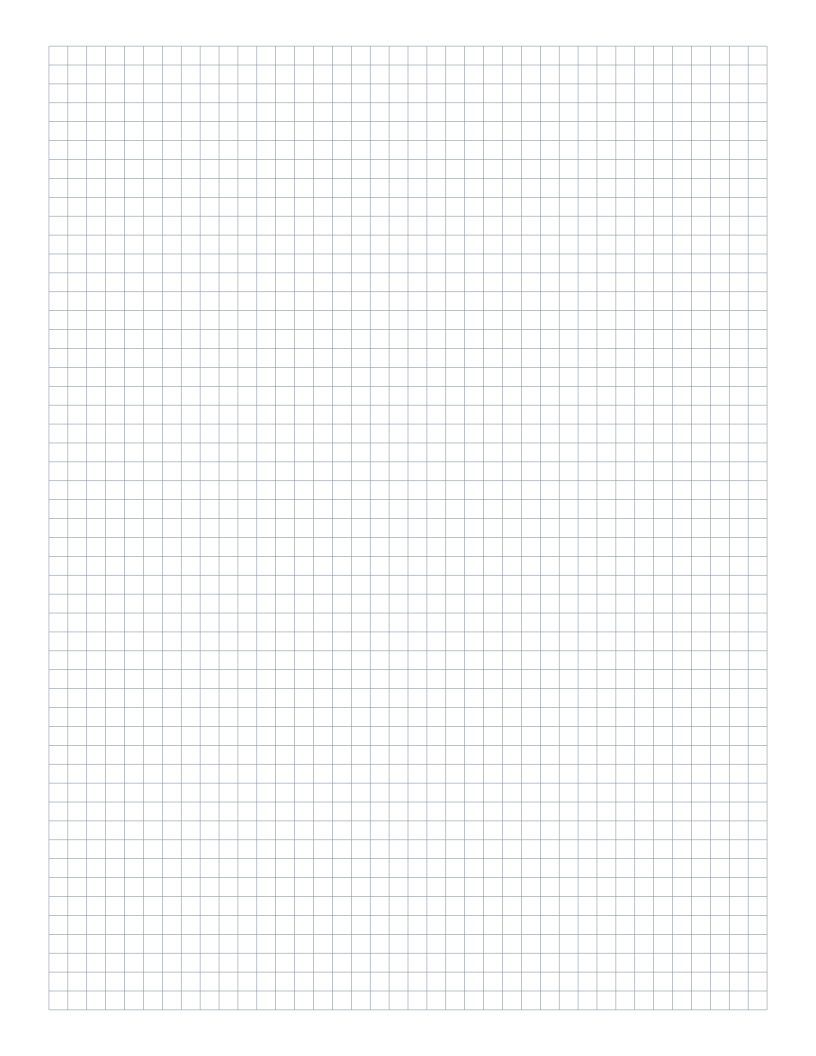
5mm Graph Paper
Standard 5mm square grid: the most popular spacing for math, engineering and general use.
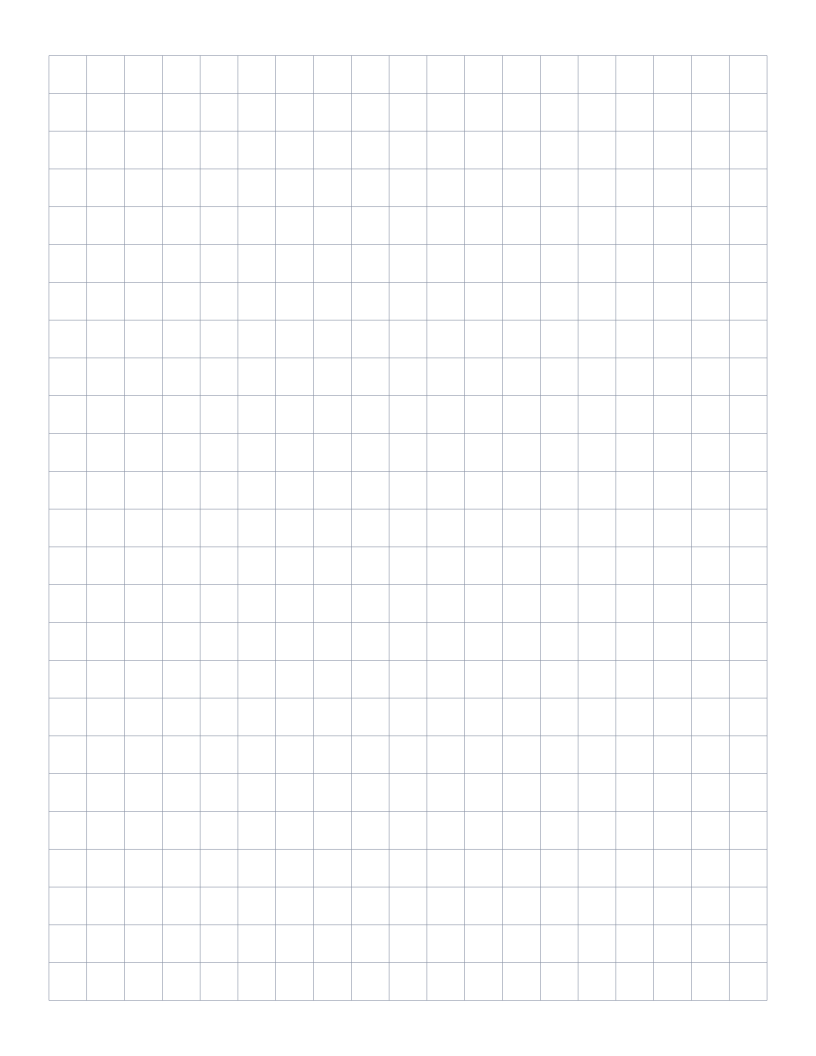
1cm Graph Paper
1 centimeter grid: the everyday graphing standard for elementary math and primary school.
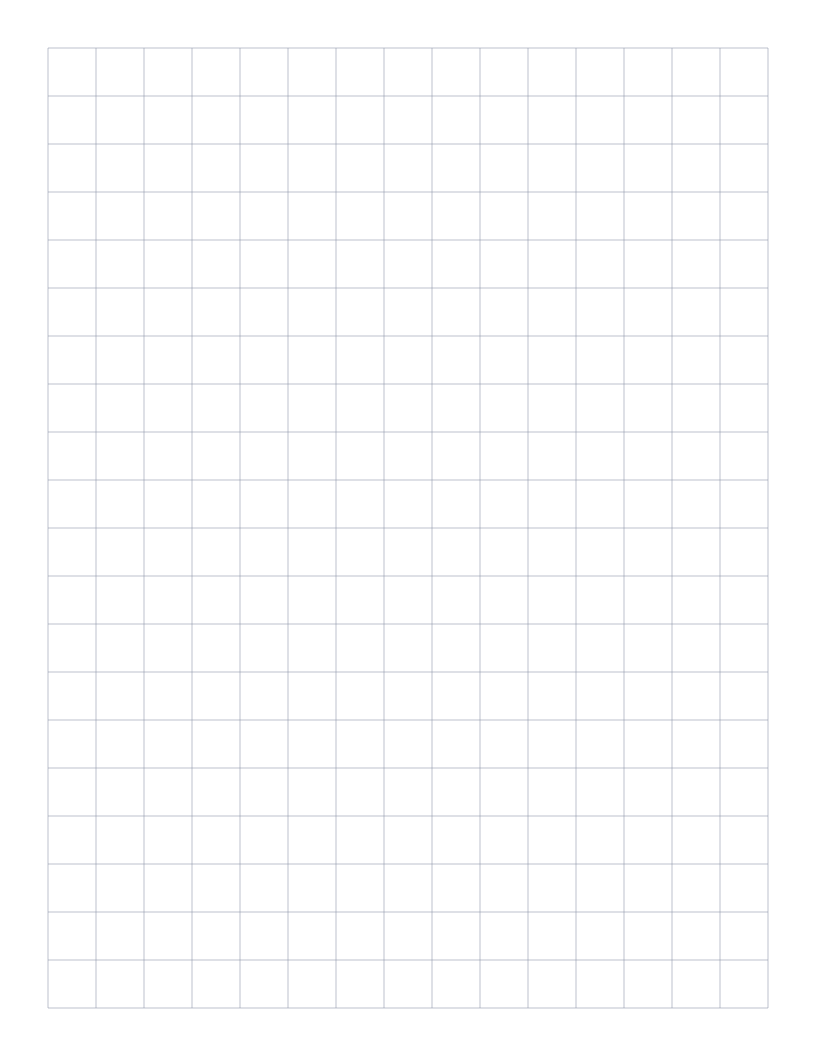
1/2 Inch Graph Paper
Two squares per inch: large grid that doubles as a 2D ruler for measurement.
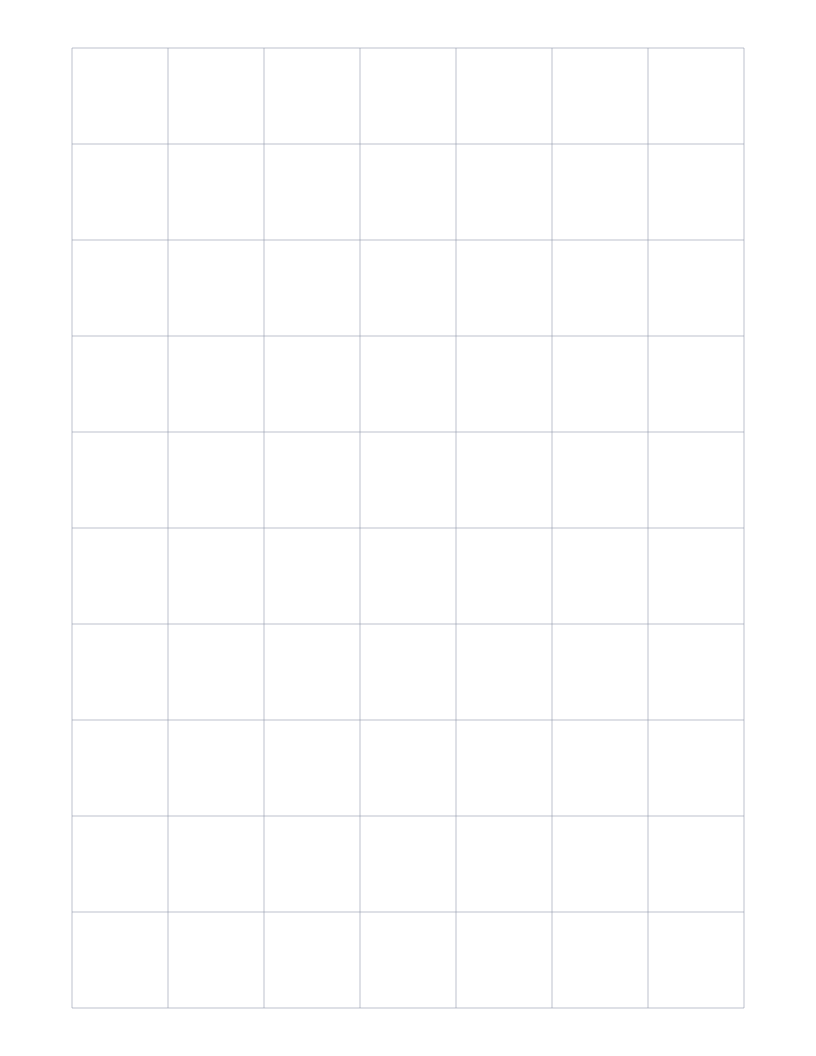
1" Graph Paper
One inch grid: the largest squares we offer, great for posters and quick layout work.