Live preview · Letter (8.5" × 11") · Gray lines
Engineering Paper
Engineering paper packs ten fine squares per inch with a bolder accent every fifth line, giving you a 0.5 inch coarse grid laid over a 0.1 inch fine grid. It's the densest practical grid for technical sketching. Small enough for circuit work, structured enough that the eye doesn't get lost.
Download generates a crisp vector PDF directly, no print dialog needed.
Choose a different paper size:
Choose a different line color:
Great for
- Engineering coursework and homework
- Lab notes, calculations and data logging
- Circuit board and breadboard prototyping
- Technical sketches and mechanical layouts
Engineering Paper at a glance
| What it is | 10 squares per inch: the classic green-tint engineering pad layout in printable form. |
|---|---|
| Category | Grid Paper |
| Paper sizes | Letter (8.5" × 11"), A4 (210 × 297 mm), 11" × 17", Legal (8.5" × 14"), A3 (297 × 420 mm), A2 (420 × 594 mm), Poster (18" × 24"), Movie Poster (27" × 40") |
| Line colors | Faint, Light, Gray, Dark, Black, Blue, Green (default: Gray) |
| Format | Vector PDF download at exact physical scale, or print directly from the browser |
| Price & license | Free. No signup or watermark. Printed sheets may be used for personal, classroom and commercial work. |
About engineering paper
Engineering paper is the US technical drawing standard that grew up alongside the slide rule. The 10-squares-per-inch ruling matches imperial decimal fractions exactly: one cell is 0.1 inch, five cells is 0.5 inch, ten cells is one inch. That meant a working engineer could lay out tenths of an inch directly without sub-dividing, which was useful because most US technical specifications quoted dimensions in thousandths. The 0.1 inch pitch is also why this paper became the prototyping companion for electronics work. Standard perfboard and breadboard hole spacing is exactly 0.1 inch, so the grid mirrors the physical pad you'll solder onto. Classic engineering pads had the grid printed on the back of the sheet (so the front stayed clean ink-wise) in a faint green tint that wouldn't reproduce on blueprints; we render it as a normal-side grid in your chosen colour.
What's on the page
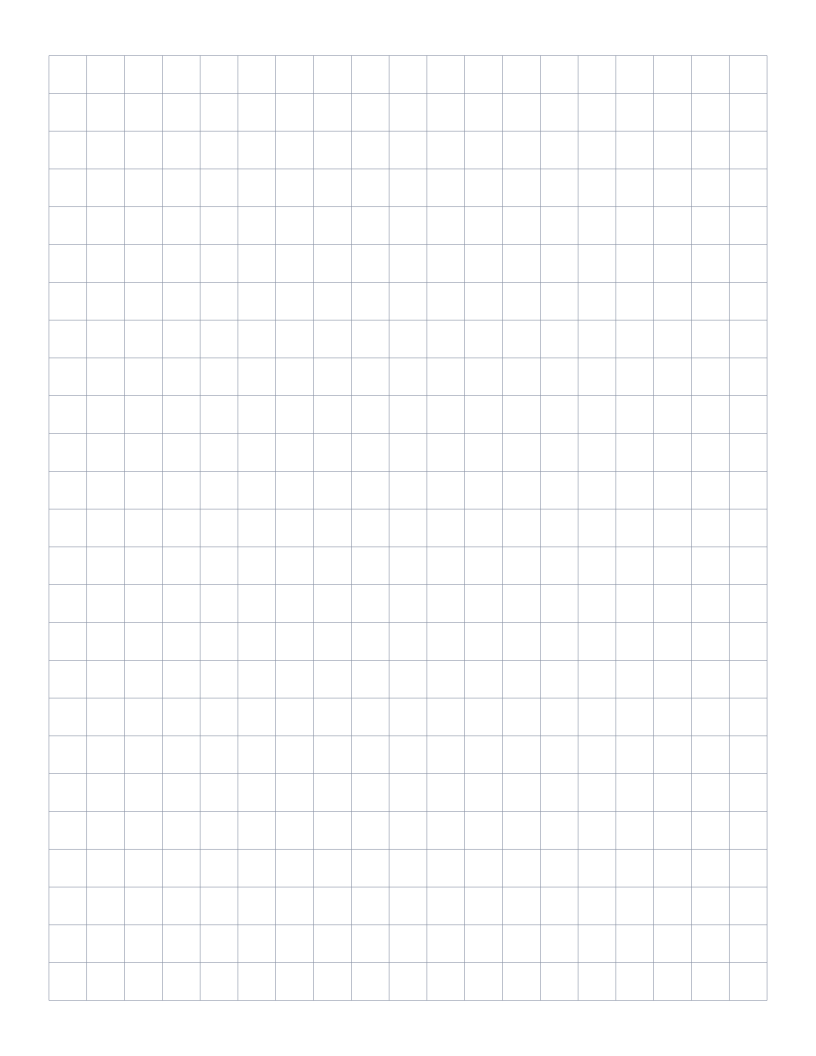
Two overlapping grids drawn together: a fine 0.1 inch (2.54 mm) hairline grid at 0.15 mm weight, and a coarser 0.5 inch (12.7 mm) accent grid at 0.25 mm weight on every fifth line. The result is the classic look of US engineering paper. Visible cell structure at the half-inch level for orientation, fine resolution within for actual drawing. On Letter you get about 15 × 20 full half-inch blocks; on Legal, 15 × 26.
How to use it well
Plan the layout at half-inch scale
Use the bold accent grid as the structure of your drawing. Block out the overall sketch using the 1/2 inch cells, then draft details using the fine 1/10 inch ruling within them. This 'major then minor' approach is how professional draftsmen used the paper for decades.
Match electronics work to the grid
The 0.1 inch pitch lines up with perfboard, breadboard, and most thru-hole components (DIPs, headers, terminal blocks). Sketch your circuit layout cell-for-hole and the transfer to physical board is one-to-one.
Use accent lines as data anchors
When plotting numerical data, put each data label on the half-inch accent line and use the fine cells between for sub-divisions. The eye reads accents as natural tick marks without needing extra annotation.
Keep handwriting on the accent grid
0.1 inch cells are too small to write digits inside. Use the half-inch accent rows as your text baselines instead. Write across the fine cells with the accent providing top/bottom alignment, the way you would on lined paper.
Common mistakes to avoid
- Treating 0.1 inch as 2.5 mm. Those are different (2.54 mm vs 2.5 mm). Close enough to overlap visually, but a precision overlay or laser-cut template for one will misalign over the other within a few inches.
- Photocopying the Faint colour. The fine grid hairlines vanish at most office copy settings. For paper that will be photocopied or scanned, use Gray or darker for both the fine and accent ruling.
- Confusing accent lines with axis lines. The accent ruling is structural, it's not a coordinate system. If you're plotting data, draw your own axes on top in a different colour so the accents stay in their role as background structure.
FAQ, Engineering Paper
Why are some engineering pads green?+
Traditional engineering pads were printed on the reverse of the sheet in a non-photo green ink. A colour calibrated to disappear when blueprints were reproduced on diazo or photostat machines. The grid stayed visible to the engineer but didn't muddy the printed copy. Modern digital printing makes this unnecessary; you can pick any grid colour you like.
Is engineering paper the same as quad ruled?+
No. Quad ruled is 1/4 inch with no accents, four squares per inch, evenly weighted. Engineering paper is 1/10 inch with a heavy line every fifth cell. Ten squares per inch with a 1/2 inch accent grid on top. Engineering paper is significantly denser and visually more complex.
Can I use it for circuit prototyping?+
Yes, it's the standard. The 0.1 inch grid matches the hole pitch on standard perfboard and most through-hole electronic components. Sketch the circuit on paper, count holes, then assemble, the layout transfers cell-for-hole.
Does it work for mechanical drawing?+
For sketching, yes, for production drawings, no. CAD has long since taken over for any drawing intended for fabrication. Engineering paper survives in coursework, lab notebooks, field sketches, and as a place to think through a design before committing to CAD.
What weight of pen should I use?+
0.3 mm to 0.5 mm reads cleanly on the fine grid without obscuring the cells underneath. Anything thicker (0.7 mm+) covers two cell widths and starts to blot out the fine resolution the paper exists to provide.
Printing tips for best results+
- 1. Click Print above. A new tab opens the template at exact size.
- 2. The print dialog appears automatically. Set Scale to 100%. Never "Fit to page", which silently shrinks every cell.
- 3. Set Margins to None or Minimum so the grid reaches the page edge.
- 4. For a PDF, click Download instead. It generates a vector PDF directly without going through the printer driver.
You might also like

5mm Graph Paper
Standard 5mm square grid: the most popular spacing for math, engineering and general use.
1cm Graph Paper
1 centimeter grid: the everyday graphing standard for elementary math and primary school.
1/4 Inch Graph Paper
Classic four-squares-per-inch quad ruled paper: the US engineering standard.
1/2 Inch Graph Paper
Two squares per inch: large grid that doubles as a 2D ruler for measurement.