Live preview · Letter (8.5" × 11") · Gray lines
Isometric Graph Paper
Isometric paper is graph paper for three dimensions. Three sets of lines, each 60° apart, give you a grid where cubes, machines, and rooms snap together without distortion. Equal-length edges in the world stay equal-length on the page.
Download generates a crisp vector PDF directly, no print dialog needed.
Choose a different paper size:
Choose a different line color:
Great for
- 3D technical drawing
- Mechanical and architectural sketches
- Game level / dungeon design
- Crystal and molecular structures
Isometric Graph Paper at a glance
| What it is | Triangular 30°/60° grid for 3D drawings, technical sketches and Minecraft-style design. |
|---|---|
| Category | Specialty |
| Paper sizes | Letter (8.5" × 11"), A4 (210 × 297 mm), 11" × 17", Legal (8.5" × 14"), A3 (297 × 420 mm), A2 (420 × 594 mm), Poster (18" × 24"), Movie Poster (27" × 40") |
| Line colors | Faint, Light, Gray, Dark, Black, Blue, Green (default: Gray) |
| Format | Vector PDF download at exact physical scale, or print directly from the browser |
| Price & license | Free. No signup or watermark. Printed sheets may be used for personal, classroom and commercial work. |
About isometric graph paper
Isometric paper solves a problem that ordinary graph paper can't: how to draw three perpendicular axes on a flat page without misrepresenting any of them. The trick is to abandon perspective entirely. Instead of one vanishing point pulling lines together, isometric projection keeps all three axes at 120° to each other, scaled equally. The result is a drawing system that early-20th-century industrial draughtsmen prized because a single sketch carries usable measurements along all three axes. Width, depth, and height, with no foreshortening to undo. Mechanical engineers still use it for exploded views. Pixel artists adopted it for game graphics from SimCity 2000 to Diablo. Tabletop RPG players sketch dungeons on it because rooms stack and align cleanly across floors.
What's on the page
Three sets of parallel lines: one running vertically, two at ±30° from horizontal. Their intersections form a tiling of small equilateral triangles, 5 mm on every side. Every intersection is a valid corner for a unit cube. Six adjacent triangles form one full cube of 5 mm × 5 mm × 5 mm in world space, shown on the page as a regular hexagon. Lines are drawn at 0.15 mm with anti-aliased rendering, since pure axis-aligned snapping leaves diagonals looking stepped.
How to use it well
Pick your three axes before drawing
Treat the vertical line as 'up', the right-leaning diagonal as 'right', the left-leaning diagonal as 'back'. Stick to that convention across the whole drawing. Switching mid-sketch is how you accidentally produce M.C. Escher impossibilities.
Count triangle edges, not hexagons
The visible hexagons are an emergent pattern. The unit you actually measure with is the triangle edge, 5 mm. A 'one unit cube' is six triangles arranged as a hexagon, but it sits two triangle edges across, not one hexagon.
Sketch the bounding box first
For any object, lightly draw the outermost cube it would fit inside, then carve away. Beginners try to draw curves and bevels directly from the page and lose track of scale within a few lines.
Approximate circles with isometric ellipses
A true circle doesn't exist on isometric paper. What you draw is an ellipse fitted into a rhombus. The trick is to draw the rhombus (an 'isometric square') first, then arc through the midpoint of each of its four edges. The result looks circular at a glance and stays consistent across views.
Common mistakes to avoid
- Mixing isometric with regular perspective in the same drawing. The two systems are mutually exclusive. Once you introduce a vanishing point, measurements stop being meaningful and the eye rejects the result.
- Drawing 'skewed cubes' with non-30° edges. Even a 2-3° drift makes the solid look unstable. Trace along existing grid lines for every straight edge; freehand only the curves.
- Assuming areas are accurate. Isometric preserves edge length only, it distorts both area and angle. Don't try to size a floor plan by counting visible triangles; use a regular 5 mm grid for that.
- Forgetting that hidden edges are still there. The 'back' face of a box has corners and intersections you can't see; if you don't sketch them lightly, the visible faces will slowly drift out of alignment.
FAQ, Isometric Graph Paper
Why 30 and 60 degrees?+
Isometric projection maps three perpendicular world axes onto the page at 120° apart. Geometrically, that means each axis sits at 30° relative to horizontal, and the angle between any pair of projected axes is 120°. The complementary angles (60° and 30°) are what you see between lines.
Is isometric the same as axonometric?+
Isometric is a specific type of axonometric. All three axes are scaled equally in isometric, that's the 'iso' part. In dimetric projection, two axes share a scale; in trimetric, all three are different. Isometric is the only one where you can measure off the page without applying a different ratio per axis.
Can I use it for accurate floor plans?+
For visualisation, yes, for measurements, no. Isometric drawings preserve edge lengths but distort area and angle, so you can't size a room by 'eyeballing' the triangles. For an accurate to-scale plan, use a regular 5 mm grid; switch to isometric only for the 3D presentation view.
What's the difference vs triangular paper?+
Triangular paper has triangles all oriented the same way (alternating up/down rows). Isometric paper has the same triangles, but they tile into hexagons aligned to 3D axes, the orientation is the whole point. The two papers look superficially similar but solve different problems.
Why use it for pixel art?+
The isometric 'video game look'. Used in SimCity 2000, Diablo, Habbo, and most cosy farming sims. Is just pixel art drawn on this exact grid. Each triangle becomes one face of a unit cube, and stacking them produces the half-3D effect without any actual 3D rendering.
Can I shade it convincingly?+
Yes, and the grid helps. The three faces of any cube catch different amounts of light: top face brightest, front face mid-tone, side face darkest. Apply that rule uniformly across every solid in the drawing and the whole scene reads as 3D even with flat colours.
Printing tips for best results+
- 1. Click Print above. A new tab opens the template at exact size.
- 2. The print dialog appears automatically. Set Scale to 100%. Never "Fit to page", which silently shrinks every cell.
- 3. Set Margins to None or Minimum so the grid reaches the page edge.
- 4. For a PDF, click Download instead. It generates a vector PDF directly without going through the printer driver.
You might also like
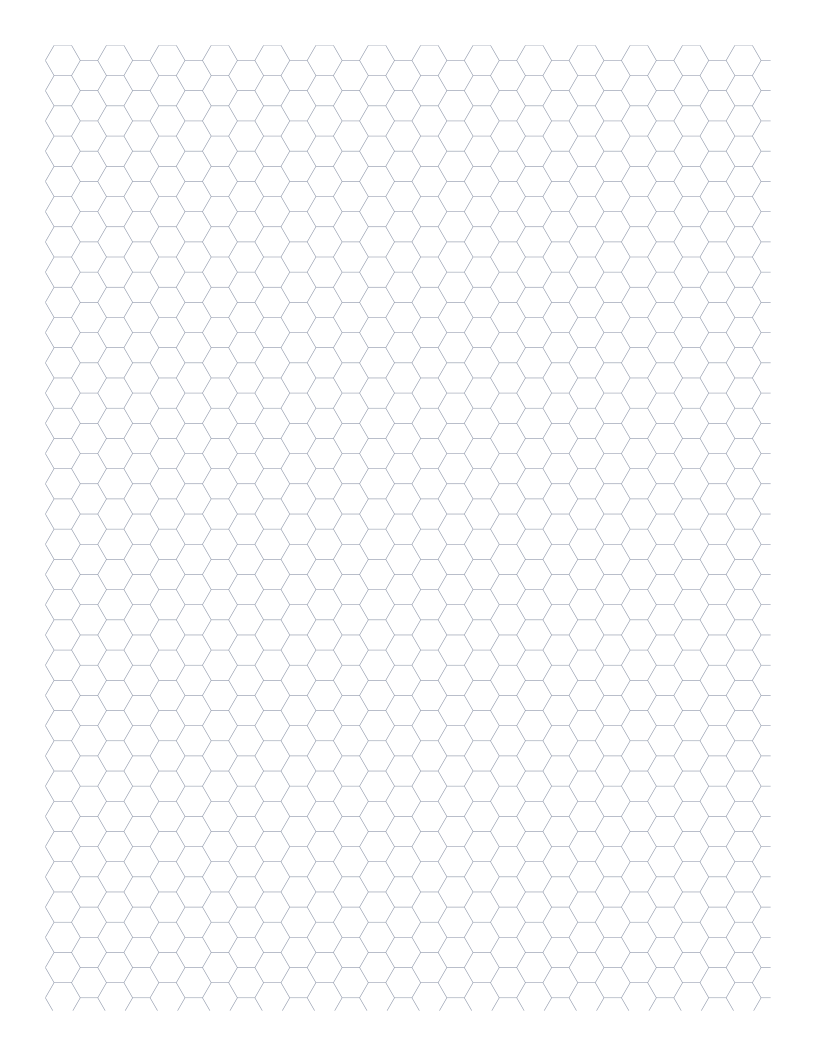
Hexagonal Graph Paper
Hexagonal tessellation: perfect for tabletop wargaming, organic chemistry and tile-based games.
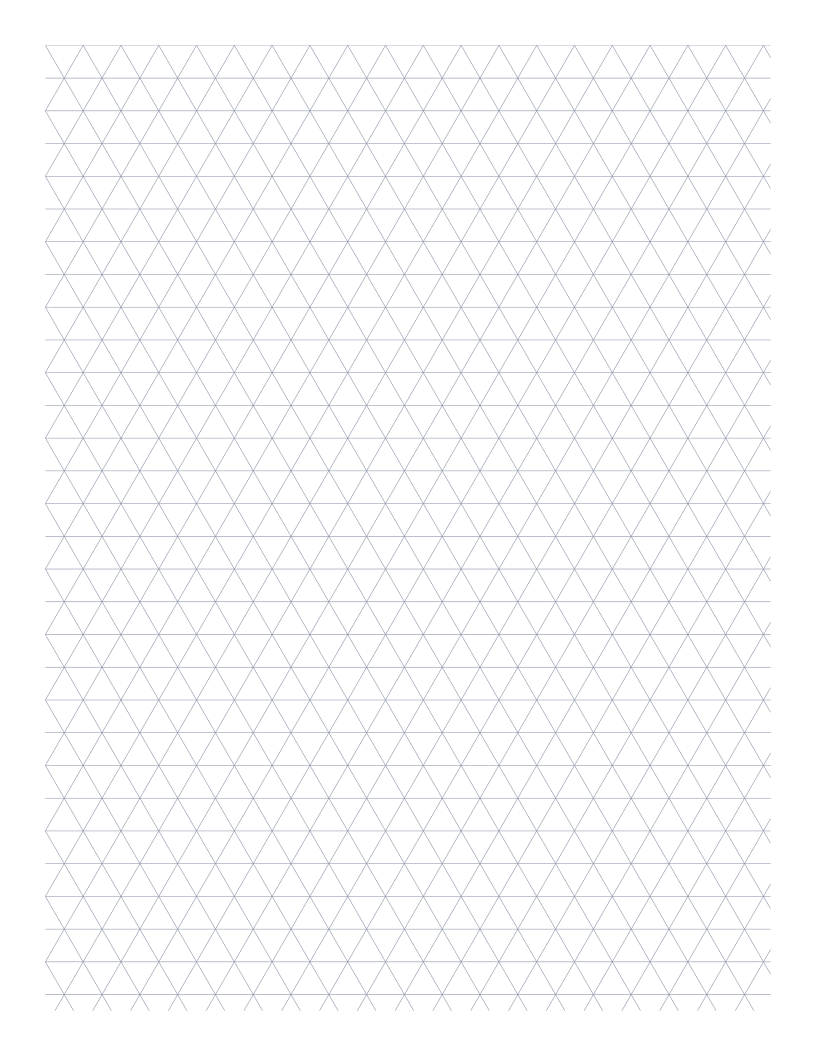
Triangular Graph Paper
Equilateral triangle grid: useful for ternary diagrams and tessellation art.
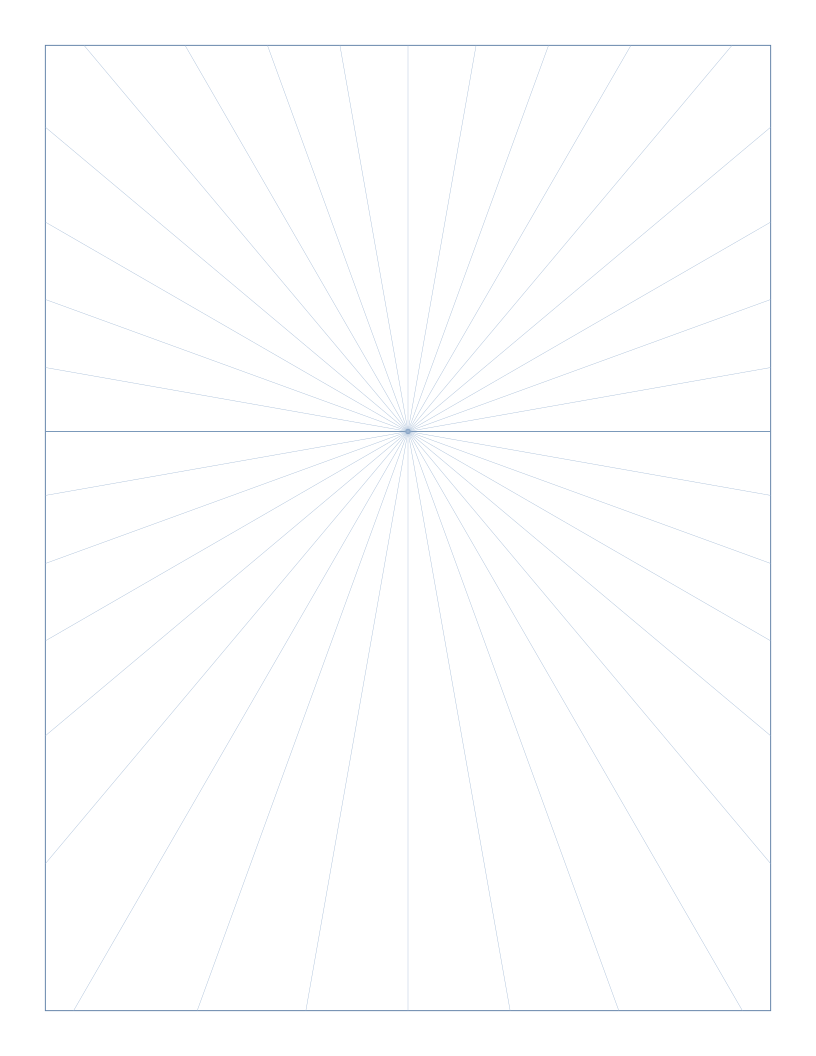
1-Point Perspective Grid
Single vanishing point on the horizon with radiating guides: the classic setup for hallways, rooms and street scenes.
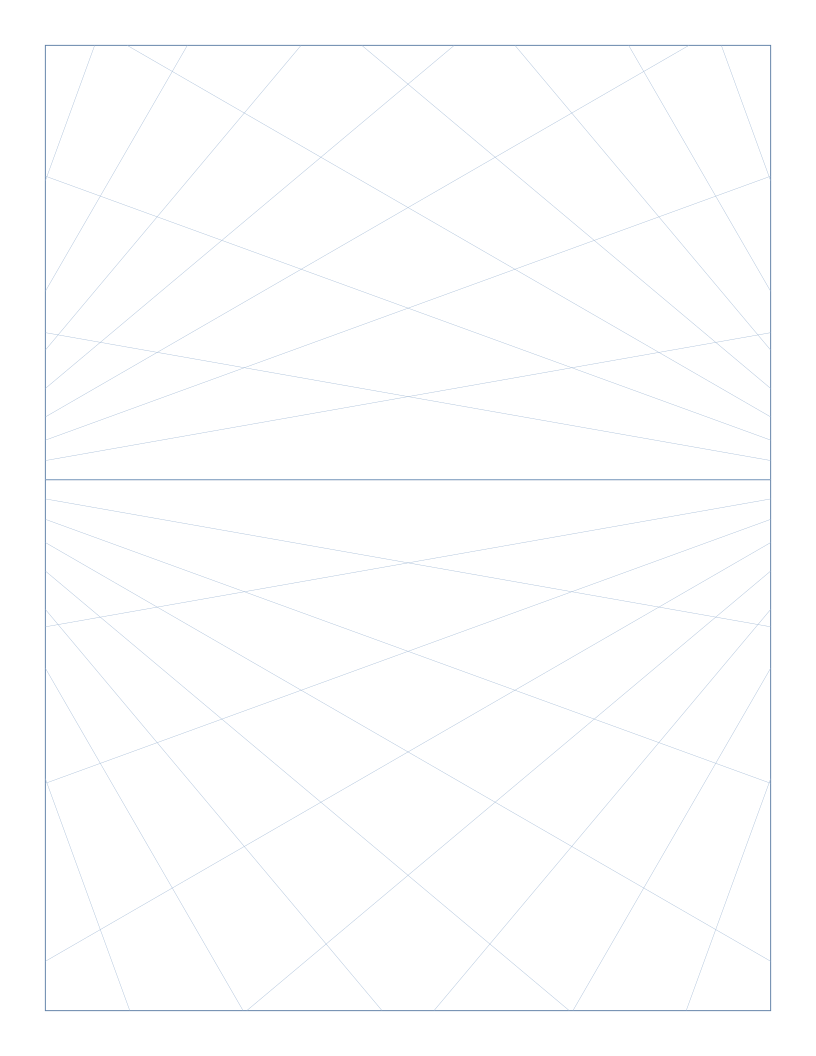
2-Point Perspective Grid
Two vanishing points on the horizon, set wide for natural-looking corners: the standard for architecture and product illustration.