Live preview · Letter (8.5" × 11") · Gray lines
Triangular Graph Paper
Triangular paper tiles the page with equilateral triangles, alternating point-up and point-down rows. It's used wherever three quantities sum to a constant (ternary plots) or where six-fold geometric symmetry matters (tessellation, Islamic geometric art).
Download generates a crisp vector PDF directly, no print dialog needed.
Choose a different paper size:
Choose a different line color:
Great for
- Ternary phase diagrams in metallurgy and materials science
- Soil texture classification triangles
- Tessellation and Islamic geometric pattern design
- Quilting and patchwork triangle templates
Triangular Graph Paper at a glance
| What it is | Equilateral triangle grid: useful for ternary diagrams and tessellation art. |
|---|---|
| Category | Specialty |
| Paper sizes | Letter (8.5" × 11"), A4 (210 × 297 mm), 11" × 17", Legal (8.5" × 14"), A3 (297 × 420 mm), A2 (420 × 594 mm), Poster (18" × 24"), Movie Poster (27" × 40") |
| Line colors | Faint, Light, Gray, Dark, Black, Blue, Green (default: Gray) |
| Format | Vector PDF download at exact physical scale, or print directly from the browser |
| Price & license | Free. No signup or watermark. Printed sheets may be used for personal, classroom and commercial work. |
About triangular graph paper
Triangular paper looks superficially like isometric paper, but it solves different problems. Isometric paper exists for drawing in 3D. Its triangles form hexagons that read as cubes. Triangular paper, by contrast, is for working in 2D where three quantities matter at once. The classic application is the ternary diagram: a system where three components add up to 100 %, plotted as a single point inside an equilateral triangle. Geologists use ternaries for rock composition. Metallurgists use them for alloy phase diagrams. Soil scientists use them for the famous USDA soil texture classification. The triangular grid gives all three axes equal visual weight, which is impossible on a rectangular grid.
What's on the page
An equilateral triangular tessellation at 10 mm edge length, in 0.15 mm hairlines. Triangles alternate point-up and point-down across each row, with three sets of parallel lines: one horizontal, two at ±60° from horizontal. On Letter you get about 19 triangles across × 29 rows; on A4, 18 × 31. The pattern fills the page inside a 12 mm margin, and every line meets the others at shared vertices.
How to use it well
Use one corner per component for ternary plots
Label each corner of a large triangle with one of your three components (100 % at the corner, 0 % at the opposite edge). Any point inside the triangle then represents a unique mixture summing to 100 %.
Read percentages parallel to the edges
On a ternary diagram, you read each component's percentage along the lines parallel to the side opposite its labelled corner. Not along the grid lines closest to it. This catches almost everyone the first time they use ternary plots.
Distinguish from isometric paper
Triangular and isometric paper look almost identical at a glance. Triangular is for 2D ternary work; isometric is for 3D drawing. Make sure you've picked the right one. The wrong template will produce a drawing that looks fine but means nothing.
Pair tessellation work with a 60° set square
For Islamic geometric art and tessellation, the grid handles 60° angles for you, but you'll want a 30-60-90 set square for any straight lines that don't follow the grid (interior subdivisions, decorative arcs, mirror axes).
Common mistakes to avoid
- Confusing triangular with isometric. The two papers look nearly identical but solve completely different problems. Triangular is for 2D work with 3-axis symmetry; isometric is for projected 3D drawing. Mixing them won't produce errors, it'll produce nonsense that looks correct.
- Plotting a ternary by counting grid lines. The grid divides the triangle into smaller triangles, but counts along edges aren't always intuitive. For published work, label the edges with percentage tick marks every 10 % so readers can interpret a point directly.
- Using it for general-purpose graphing. Triangular paper isn't a substitute for Cartesian graph paper. It lacks orthogonal axes, can't plot (x, y) data, and has no notion of x = 0 or y = 0. Use it only when three-component symmetry matters.
FAQ, Triangular Graph Paper
How is this different from isometric paper?+
Isometric paper is for drawing 3D objects on a flat page, three axes at 120°, treated as up/right/back. Triangular paper is for 2D problems with three-fold symmetry, especially ternary diagrams. Geometrically they share the same line directions, but the intended use is opposite: one for 3D illustration, one for 3-component analysis.
What's a ternary diagram?+
A plot for systems where three components sum to 100 %. Each corner of an equilateral triangle represents 100 % of one component; any interior point is a unique three-way mixture. Common in metallurgy (alloy compositions), soil science (sand/silt/clay), and chemistry (three-phase systems).
Can I use triangular paper for tessellation art?+
Yes. It's one of the standard rulings for Islamic geometric art, M.C. Escher-style tessellations, and quilting block design. Any pattern with six-fold symmetry maps naturally onto this grid.
Why are triangles 10 mm and not 5 mm?+
Smaller triangles get visually noisy fast because each row contains twice as many lines as a square grid of similar size. 10 mm gives readable cells without crowding; for finer work, you can also use isometric (which has the same geometry but at 5 mm).
Does it work for graph theory?+
Poorly. Graph theory diagrams need free placement of nodes and edges. A constraining grid like this one forces unnatural-looking layouts. Use a dot grid or blank paper for graph theory.
Printing tips for best results+
- 1. Click Print above. A new tab opens the template at exact size.
- 2. The print dialog appears automatically. Set Scale to 100%. Never "Fit to page", which silently shrinks every cell.
- 3. Set Margins to None or Minimum so the grid reaches the page edge.
- 4. For a PDF, click Download instead. It generates a vector PDF directly without going through the printer driver.
You might also like
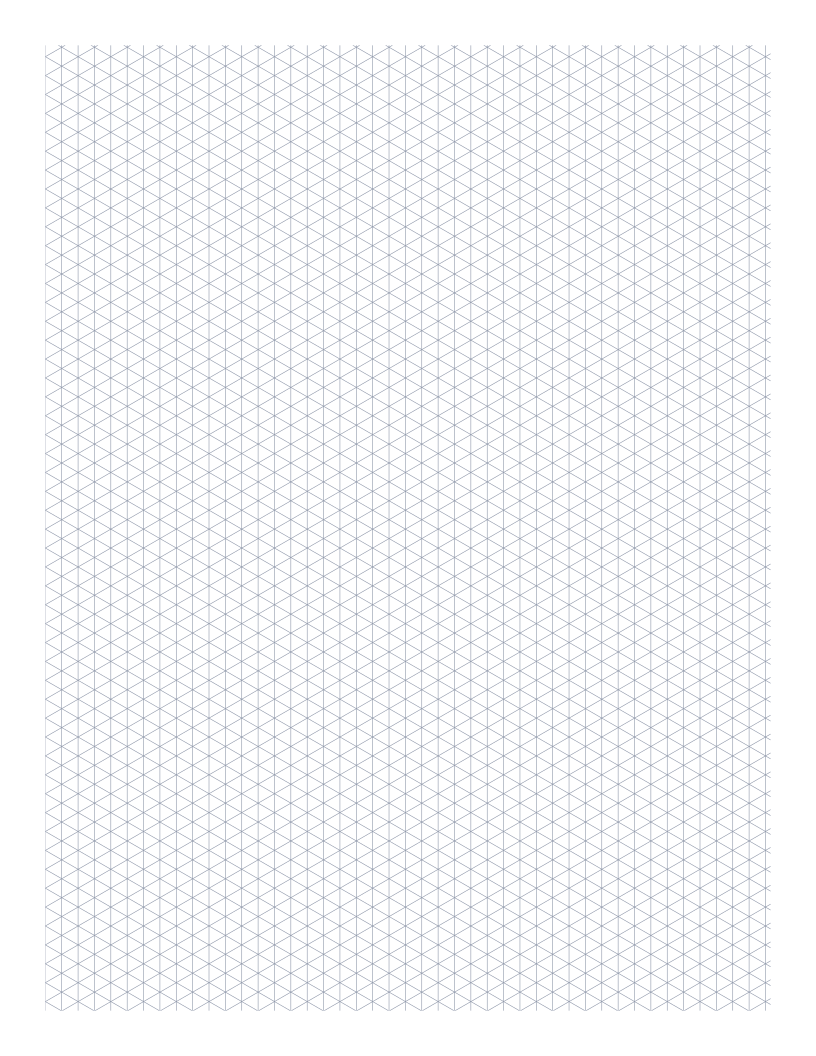
Isometric Graph Paper
Triangular 30°/60° grid for 3D drawings, technical sketches and Minecraft-style design.
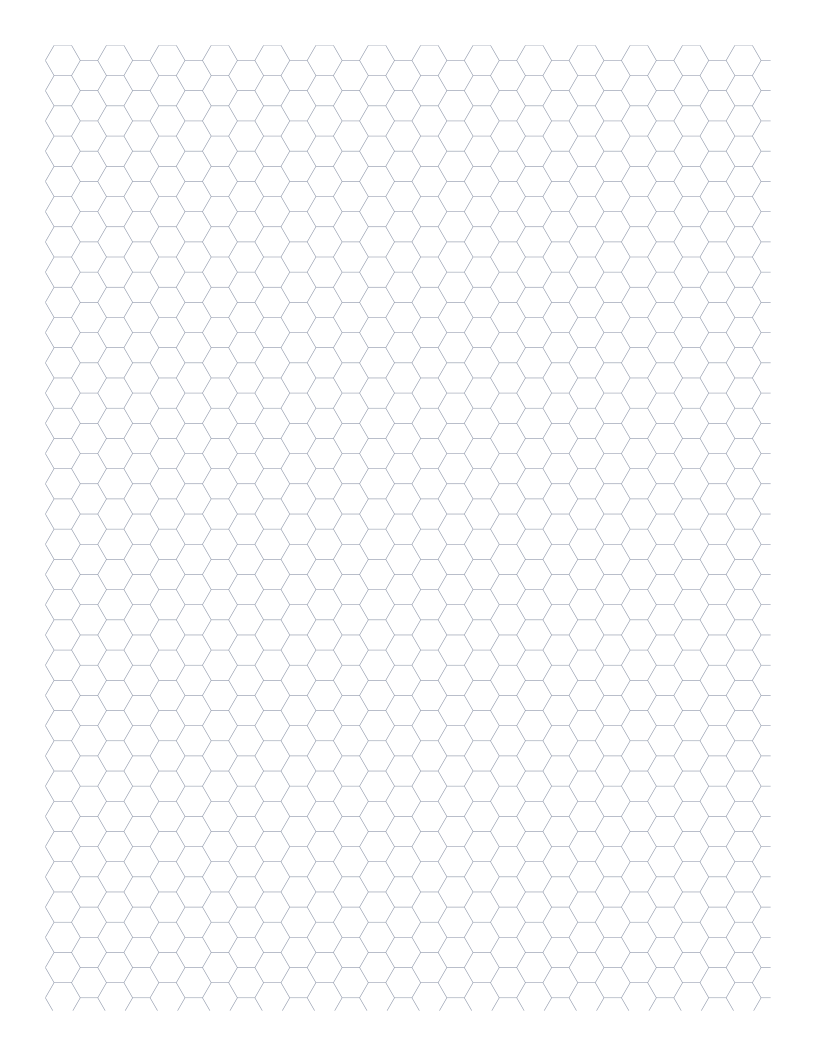
Hexagonal Graph Paper
Hexagonal tessellation: perfect for tabletop wargaming, organic chemistry and tile-based games.
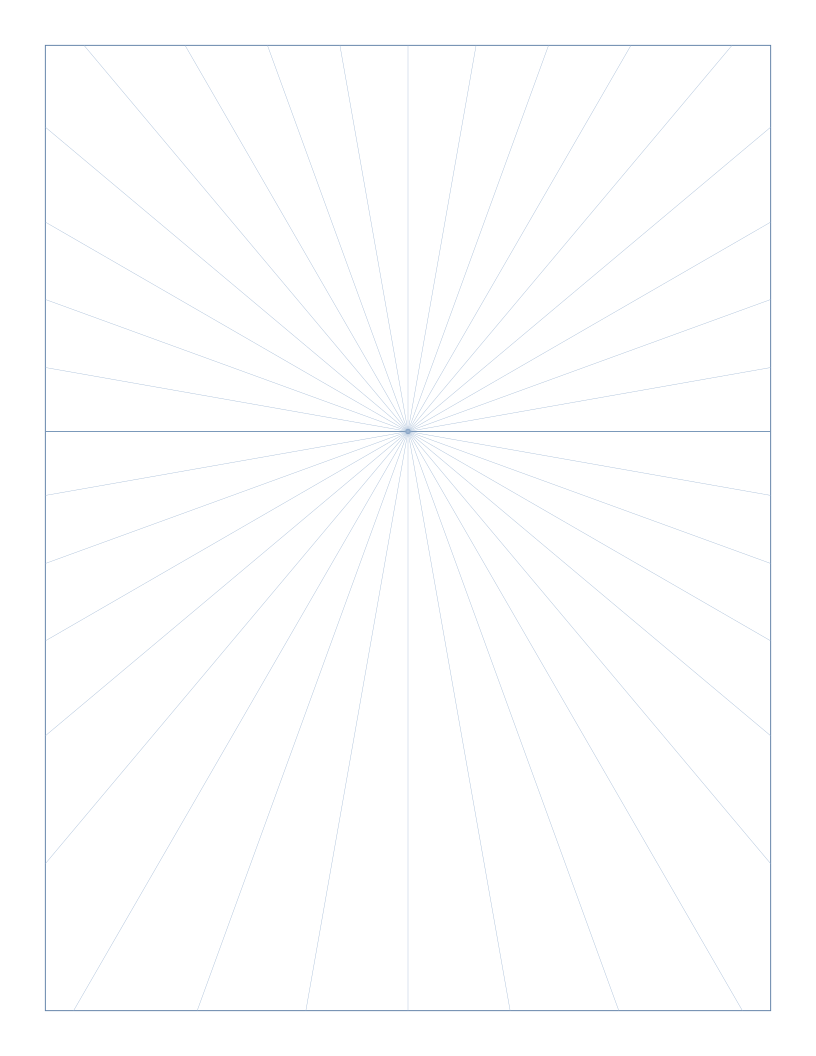
1-Point Perspective Grid
Single vanishing point on the horizon with radiating guides: the classic setup for hallways, rooms and street scenes.
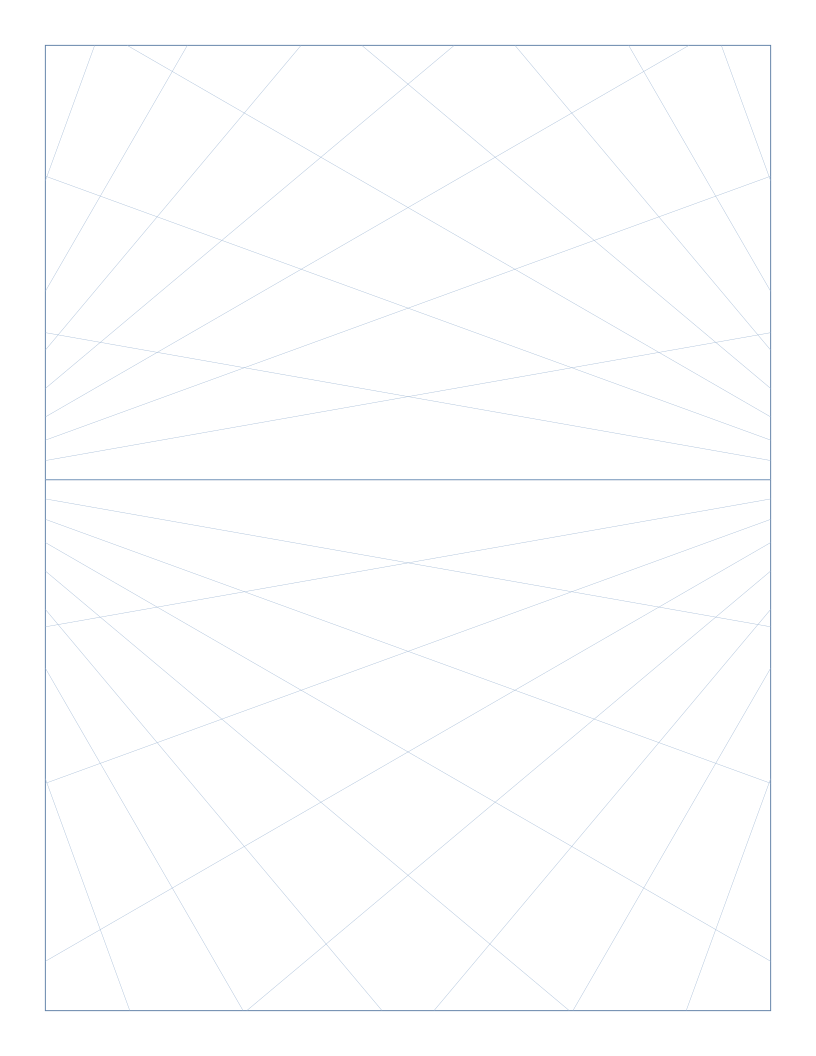
2-Point Perspective Grid
Two vanishing points on the horizon, set wide for natural-looking corners: the standard for architecture and product illustration.