Live preview · Letter (8.5" × 11") · Gray lines
Millimeter Graph Paper (1mm)
Millimeter paper is the precision end of graph paper: a 1 mm grid with a medium line every 5 mm and a bold line every centimeter. It's the paper for plotting lab data to the nearest millimeter, drawing parts at true scale, and any job where a 5 mm cell is too coarse.
Download generates a crisp vector PDF directly, no print dialog needed.
Choose a different paper size:
Choose a different line color:
Great for
- Physics and chemistry lab graphs plotted to the nearest millimeter
- Scale drawings of mechanical parts and small objects
- Sewing, model-making and craft pattern drafting
- Reading measurements directly off a printed plot
Millimeter Graph Paper (1mm) at a glance
| What it is | Classic millimeter paper: 1 mm squares with heavier lines every 5 mm and bold centimeter lines, for precise plotting and scale drawing. |
|---|---|
| Category | Grid Paper |
| Paper sizes | Letter (8.5" × 11"), A4 (210 × 297 mm), 11" × 17", Legal (8.5" × 14"), A3 (297 × 420 mm), A2 (420 × 594 mm), Poster (18" × 24"), Movie Poster (27" × 40"), Letter Landscape (11" × 8.5"), A4 Landscape (297 × 210 mm), Tabloid Landscape (17" × 11") |
| Line colors | Faint, Light, Gray, Dark, Black, Blue, Green (default: Gray) |
| Format | Vector PDF download at exact physical scale, or print directly from the browser |
| Price & license | Free. No signup or watermark. Printed sheets may be used for personal, classroom and commercial work. |
About millimeter graph paper (1mm)
Millimeter graph paper is the standard plotting paper of the metric world's laboratories and drawing offices. Three line weights do the work: the faint 1 mm lines give resolution, the medium 5 mm lines let you count in fives without losing your place, and the bold 1 cm lines act as the main scale. Because every line sits on an exact millimeter, the page is a two-dimensional ruler: a point plotted 37 mm along and 52 mm up can be read back from the grid with no ruler at all. That makes it the paper of choice wherever a graph is a measurement rather than a sketch, from school physics practicals that ask you to read a gradient off your line of best fit, to engineers drafting a bracket at 1:1 before it goes into CAD.
What's on the page
A 1 mm grid in hairline (0.1 mm) lines, with medium 0.15 mm lines every 5 mm and bold 0.25 mm lines every 10 mm. The grid is trimmed to whole centimeters and centred on the page: 19 × 25 cm on US Letter and 18 × 27 cm on A4. Landscape sizes simply swap the two, giving 25 × 19 cm on Letter landscape. Lines run cleanly to the grid edge, so every centimeter block is complete.
How to use it well
Choose your scale in whole centimeters
Pick a scale where one centimeter equals a round number (1, 2, 5, 10, 100 units). Every bold line is then a labelled tick, and each millimeter is exactly a tenth of that, so you can plot and read values to one extra digit.
Count in fives on the medium lines
The 5 mm lines exist so you never have to count past five small squares. Find the nearest bold or medium line, then count the remaining millimeters. It's faster and far less error-prone than counting from the axis.
Use a sharp pencil
A 0.5 mm mechanical pencil or a well-sharpened HB is the right tool. A blunt pencil or a 0.7 mm pen draws a line as wide as one cell, which throws away the resolution the paper gives you.
Pick Light or Faint for dense sketches
The 1 mm grid is busy. If your drawing is the important part, switch the line colour to Light or Faint so the grid recedes behind your work while the centimeter lines stay readable.
Common mistakes to avoid
- Printing with 'Fit to page'. A 3 percent shrink turns every centimeter into 9.7 mm, which is exactly the size of error millimeter paper exists to avoid. Print at 100 percent scale and check one centimeter block with a ruler.
- Plotting to more precision than the data has. Being able to plot to 0.1 of a unit doesn't mean your measurements are that precise. Draw error bars where they matter instead of implying accuracy you don't have.
- Photocopying the hairlines. The 1 mm lines are 0.1 mm wide and are often lost on photocopies or low-quality scans. Print a fresh copy for each student rather than copying a copy.
FAQ, Millimeter Graph Paper (1mm)
Is millimeter paper the same as metric graph paper?+
It's the finest common type. Metric graph paper also comes in 2 mm, 5 mm and 1 cm rulings. Millimeter paper is the one with three line weights (1 mm, 5 mm and 1 cm), used when you need to plot or measure to the nearest millimeter.
How big is the grid on A4?+
18 × 27 cm, which is 180 × 270 millimeter squares. On US Letter it's 19 × 25 cm. The grid is trimmed to whole centimeters so every bold block is complete.
Why are there three different line weights?+
So you can find your place quickly. Bold lines mark centimeters, medium lines mark 5 mm, and faint lines mark single millimeters. Without the heavier lines a page of 1 mm squares is almost impossible to count across.
Will the lines be exactly 1 mm apart when printed?+
Yes, at 100 percent scale. The PDF is drawn in millimeters, so the only way to lose accuracy is browser or printer scaling. Measure a 10 cm stretch of the printed grid: it should read 100 mm.
Can I print it in landscape?+
Yes. Choose Letter landscape, A4 landscape or 11 × 17 landscape from the size picker. The grid is the same 1 mm ruling, just wider than it is tall, which suits graphs with a long horizontal axis such as time series.
Printing tips for best results+
- 1. Click Print above. A new tab opens the template at exact size.
- 2. The print dialog appears automatically. Set Scale to 100%. Never "Fit to page", which silently shrinks every cell.
- 3. Set Margins to None or Minimum so the grid reaches the page edge.
- 4. For a PDF, click Download instead. It generates a vector PDF directly without going through the printer driver.
You might also like
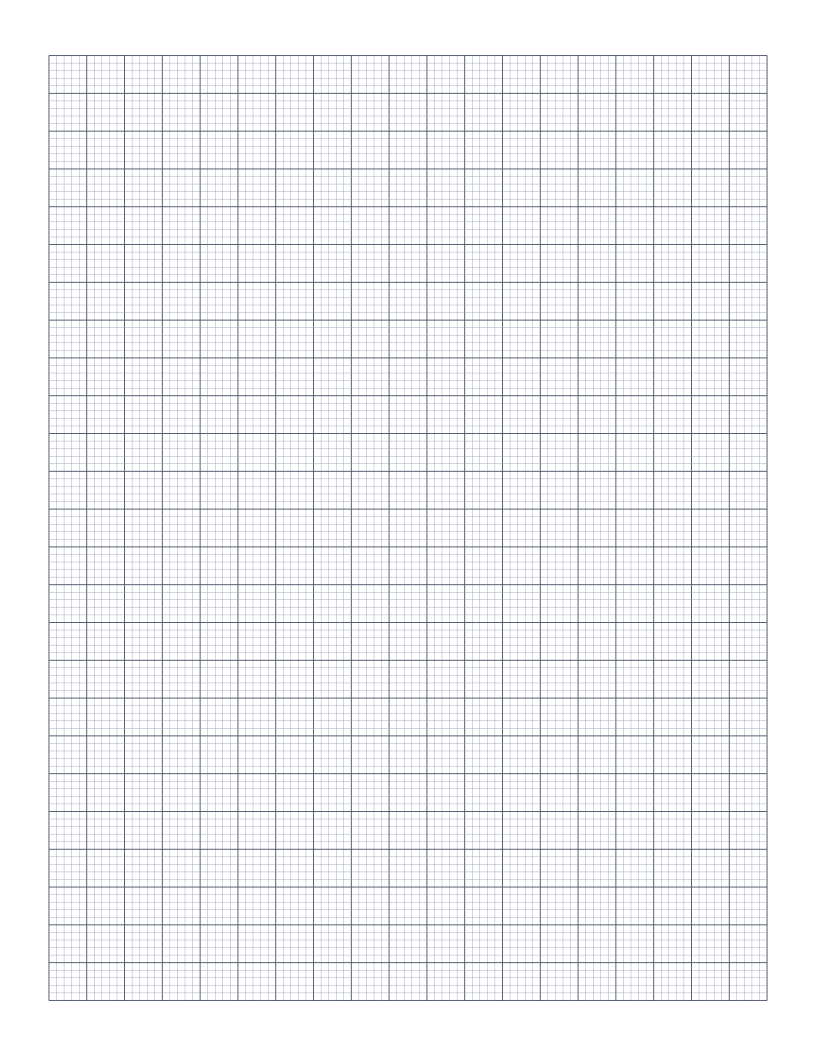
2mm Graph Paper
2 mm squares with a bold line every centimeter: finer than 5 mm paper, easier on the eye than millimeter paper.
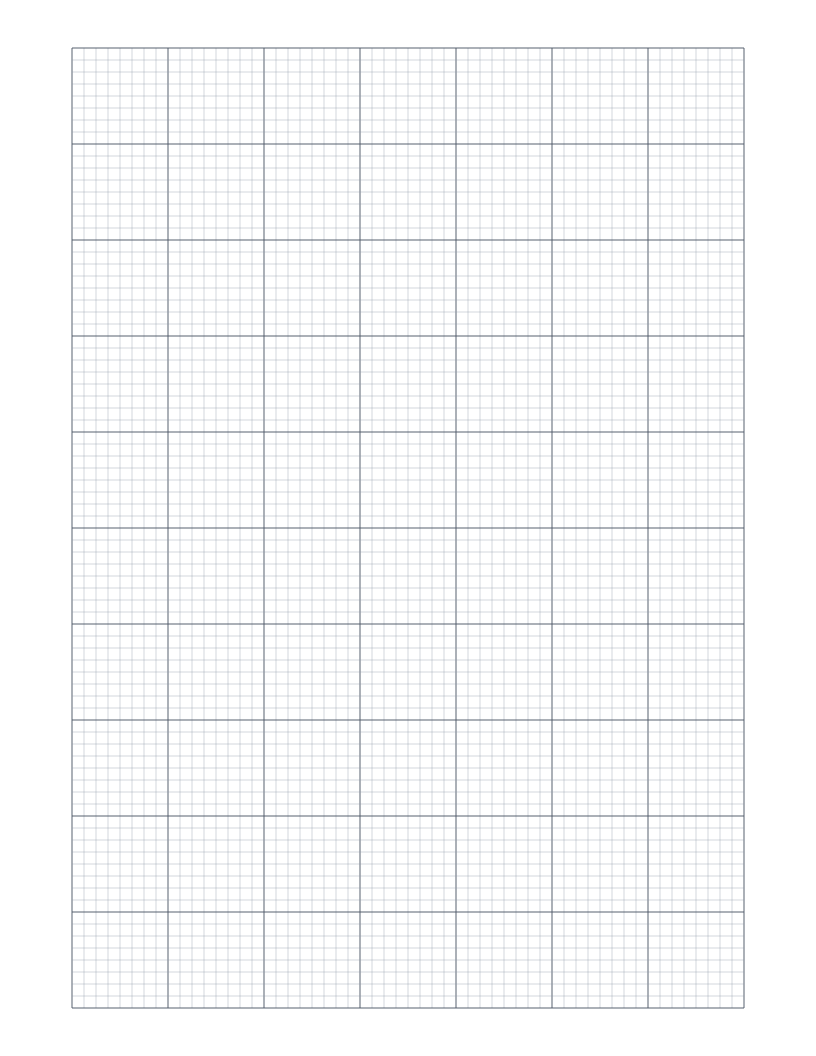
1/8 Inch Graph Paper
Eight squares per inch with a bold line every inch: a fine imperial grid for detailed plans, drafting and scale drawings.
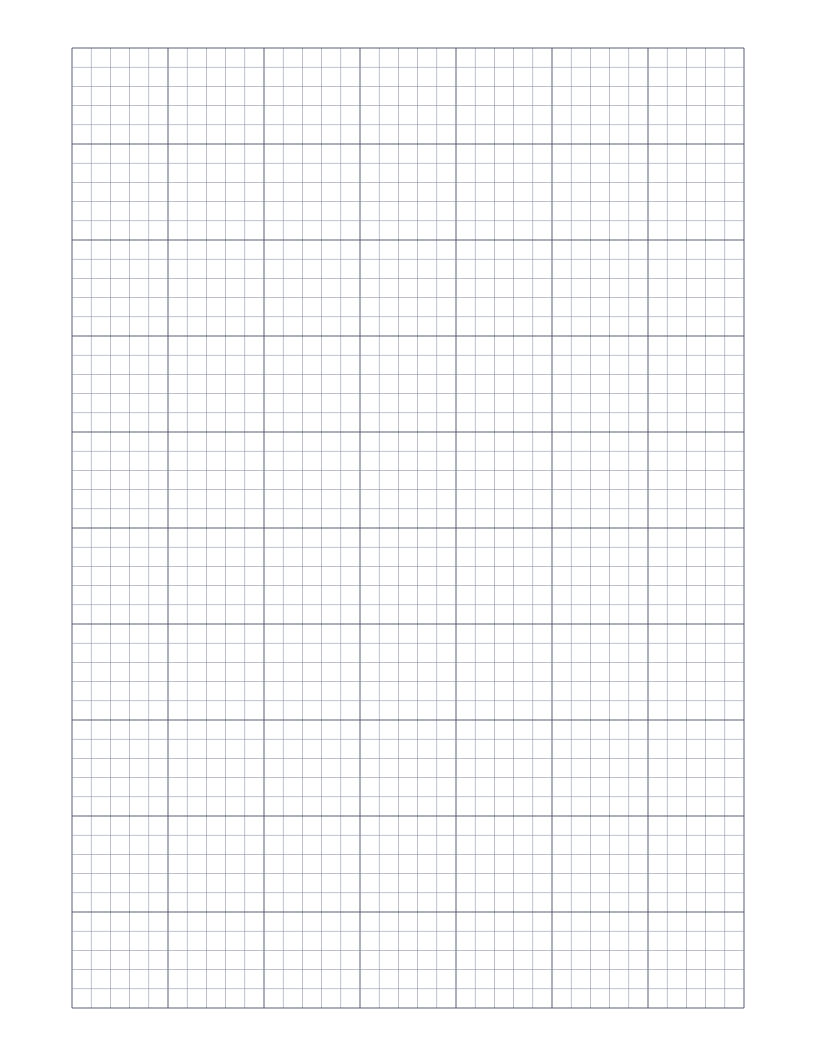
5 Squares Per Inch Graph Paper
Five squares per inch with a bold line every inch: the ruling of classic engineering computation pads and cross-section paper.
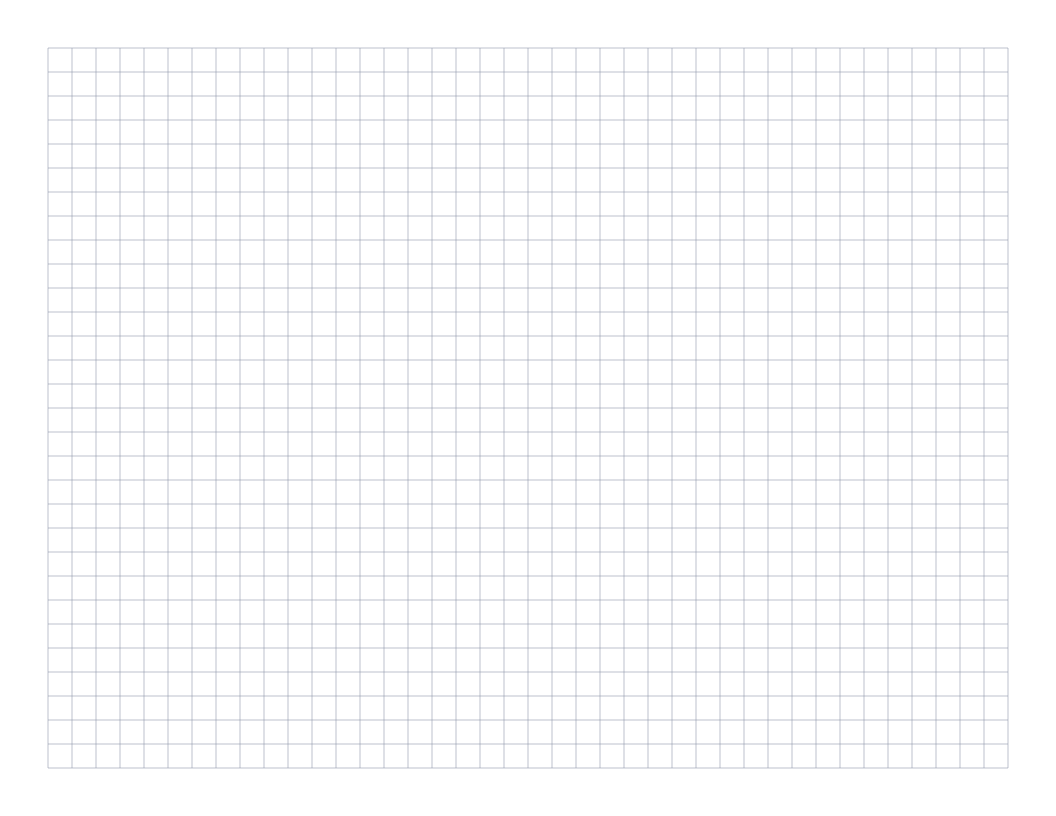
Landscape Graph Paper
Quarter-inch graph paper in landscape orientation: a wide page for timelines, charts and plans that run sideways.