Live preview · Letter (8.5" × 11") · Gray lines
Bode Plot Paper
A Bode plot has a logarithmic frequency axis (decades) and a linear gain axis (dB). The format makes asymptotic frequency-response sketches drawable as straight lines, which is why every electrical engineering and control systems textbook teaches the asymptotic approximation method on this exact paper.
Download generates a crisp vector PDF directly, no print dialog needed.
Choose a different paper size:
Choose a different line color:
Great for
- Sketching the frequency response of analog filters
- Designing compensators and PID loops by asymptotic approximation
- Estimating gain and phase margins for control-system stability
- Verifying simulated transfer functions against hand calculations
Bode Plot Paper at a glance
| What it is | Log-frequency horizontal axis with linear gain (dB) vertical axis: the standard sheet for sketching frequency response. |
|---|---|
| Category | Scientific |
| Paper sizes | Letter (8.5" × 11"), A4 (210 × 297 mm), 11" × 17", Legal (8.5" × 14"), A3 (297 × 420 mm), A2 (420 × 594 mm), Poster (18" × 24"), Movie Poster (27" × 40") |
| Line colors | Faint, Light, Gray, Dark, Black, Blue, Green (default: Gray) |
| Format | Vector PDF download at exact physical scale, or print directly from the browser |
| Price & license | Free. No signup or watermark. Printed sheets may be used for personal, classroom and commercial work. |
About bode plot paper
The Bode plot is named for Hendrik Bode, the Bell Labs engineer who in the 1930s developed the asymptotic approximation method that bears his name. The insight is simple: in the frequency response of a linear system, each pole and zero contributes a piecewise-linear approximation on a log-log plot (or log-linear, for magnitude in dB). A first-order pole at angular frequency ωp contributes a flat segment up to ωp, then drops at –20 dB per decade beyond. A first-order zero contributes the opposite. By sketching these contributions and adding them graphically, you can produce an accurate frequency-response plot for an arbitrary linear transfer function in minutes, by hand, with no computer assistance. The method dominated electrical engineering until the early 1980s; even after simulators became cheap, the asymptotic plot remains the standard teaching tool because it builds the intuition for what each pole and zero 'does' in the frequency response. The paper itself is the canvas on which this construction happens: log frequency on the x-axis (so each decade is one ruler-length wide), gain in dB on the y-axis (so each 20 dB is one ruler-length tall), and the resulting straight-line segments are easy to draw with a straightedge.
What's on the page
A 4-decade log frequency axis along the bottom (each decade subdivided at the 2, 3, … 9 minor lines, with major lines at the decade boundaries) and a linear dB axis on the left covering 0 dB down to –60 dB in 10 dB increments. Major gridlines every 20 dB (at 0, –20, –40, –60) and minor gridlines every 10 dB. Axis labels mark frequency in Hz and gain in dB. The whole layout matches the convention used in most undergraduate EE textbooks.
How to use it well
Sketch by asymptotes first, smooth later
For each pole or zero, draw the piecewise-linear asymptotic contribution. The actual response curves smoothly through the corners (3 dB below the asymptote at the corner frequency for a first-order pole), but the asymptotic sketch is the right first step. Smooth the corners only after the overall shape is correct.
Count slope changes at each corner
At each pole, the slope drops by 20 dB per decade. At each zero, it rises by 20 dB per decade. By the time you've passed all poles and zeros, you know the asymptotic slope at high frequency. If your sketch doesn't match that high-frequency slope, you've miscounted somewhere.
Label corner frequencies on the plot
Every corner on the Bode plot has a known frequency — the pole or zero that caused it. Label each corner with its frequency directly on the paper. This makes debugging much faster when the sketch doesn't match the simulation.
Use the same paper for related plots
Magnitude (this template) and phase are typically plotted on stacked sheets that share the frequency axis. Print two copies for related Bode plots; align them vertically along the frequency axis when comparing magnitude and phase.
Common mistakes to avoid
- Confusing dB with linear gain. A gain of 100× is 40 dB (20·log₁₀(100)); a gain of 1000× is 60 dB. Reading 'dB' as 'just a number' will produce systematic errors of orders of magnitude.
- Forgetting to use the log axis for frequency. On linear paper, a Bode plot looks completely different — the straight-line asymptotes become curves and the construction method falls apart. Always use semi-log or log paper for frequency-response work.
- Skipping the 3 dB correction at corner frequencies. The asymptotic plot is a piecewise-linear approximation; the actual response is 3 dB below the asymptote at the corner of a first-order pole (and 3 dB above for a zero). For coarse sketches, the correction doesn't matter; for precise reading, it does.
FAQ, Bode Plot Paper
Why dB instead of linear gain?+
Because dB is logarithmic, and the products of linear gains (from cascading amplifier stages or filter sections) become sums on the log scale. A 10× amplifier followed by a 5× amplifier has gain 50× = 34 dB; on a Bode plot, you add 20 dB and 14 dB graphically. Linear gain doesn't have this property.
How does this differ from [log-log paper](/graph-paper/log-log-graph-paper) or [semi-log paper](/graph-paper/semi-log-graph-paper)?+
Semi-log paper has a linear x-axis and log y-axis. Log-log has both axes log. Bode plot paper has log x (frequency) and linear y (gain in dB). The 'log' in 'log gain' is hidden in the dB unit itself — you plot dB on a linear axis, but dB is already logarithmic.
Why 4 decades and 60 dB?+
Four decades of frequency covers most undergraduate EE filter problems (e.g., 1 Hz to 10 kHz). 60 dB of dynamic range matches typical filter rolloff for first or second-order systems. Higher-order systems may need a wider range; we may add variants if there's demand.
Where does the phase plot go?+
On a separate sheet (or a separate region of the same sheet, in published textbooks). The magnitude and phase Bode plots share the frequency axis but have different y-axes (dB vs degrees). For a magnitude-only sketch (this template), phase is implicit but not plotted.
Is the Bode plot still used in industry?+
Yes, ubiquitously. Modern simulators (SPICE, MATLAB, Python control libraries) produce Bode plots as standard output. Engineers still sketch them by hand for back-of-envelope estimates, design intuition, and stability margin reading. The format is unchanged since Bode's time.
Printing tips for best results+
- 1. Click Print above. A new tab opens the template at exact size.
- 2. The print dialog appears automatically. Set Scale to 100%. Never "Fit to page", which silently shrinks every cell.
- 3. Set Margins to None or Minimum so the grid reaches the page edge.
- 4. For a PDF, click Download instead. It generates a vector PDF directly without going through the printer driver.
You might also like
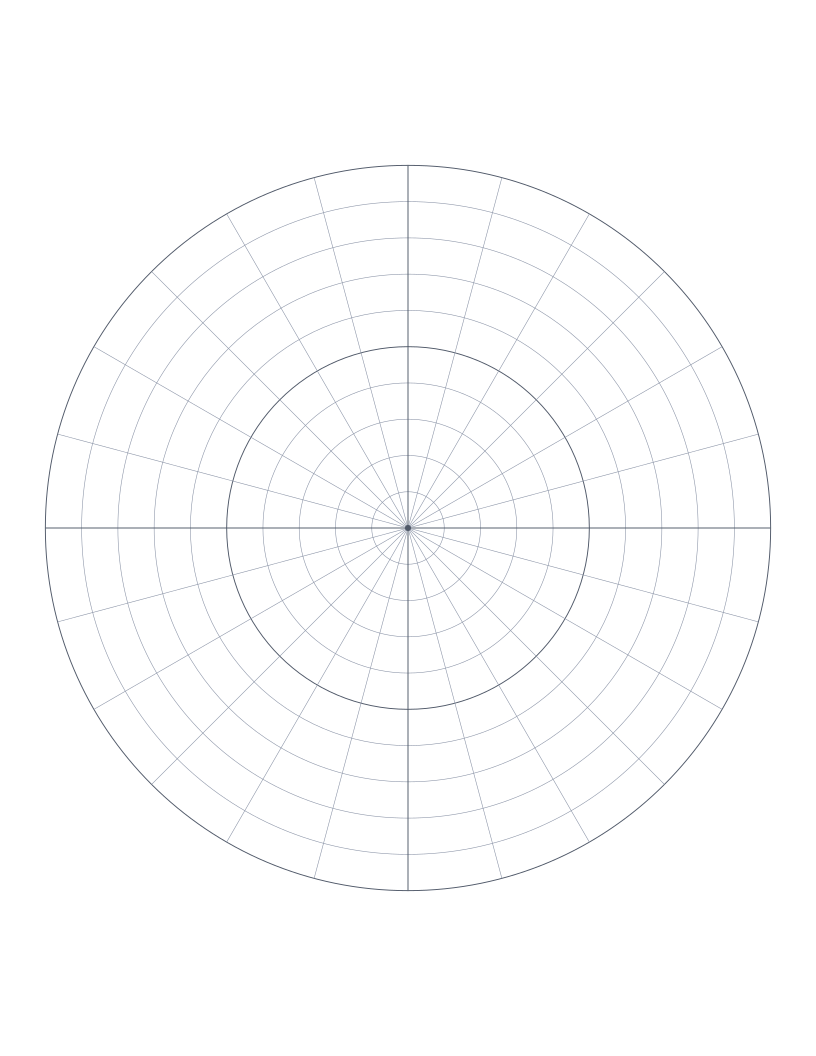
Polar Graph Paper
Concentric circles with radial spokes: for polar coordinates, vector diagrams and circular design.
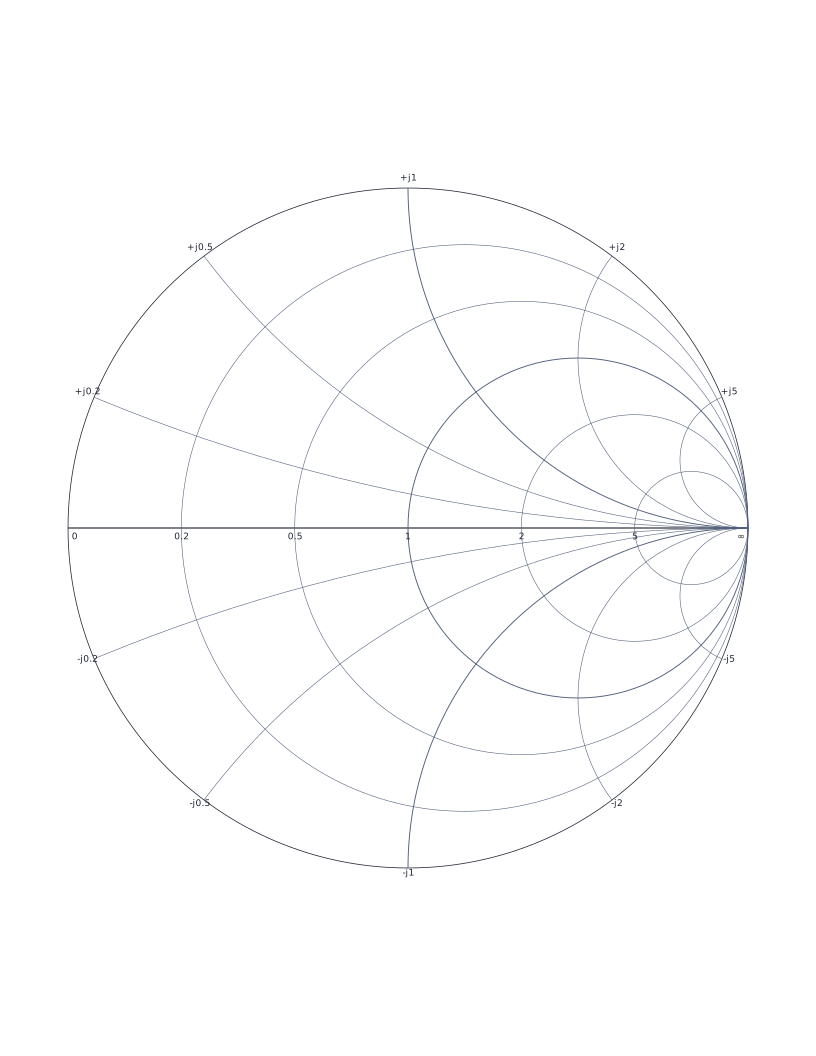
Smith Chart
Classic Smith chart for transmission line impedance matching and RF engineering.
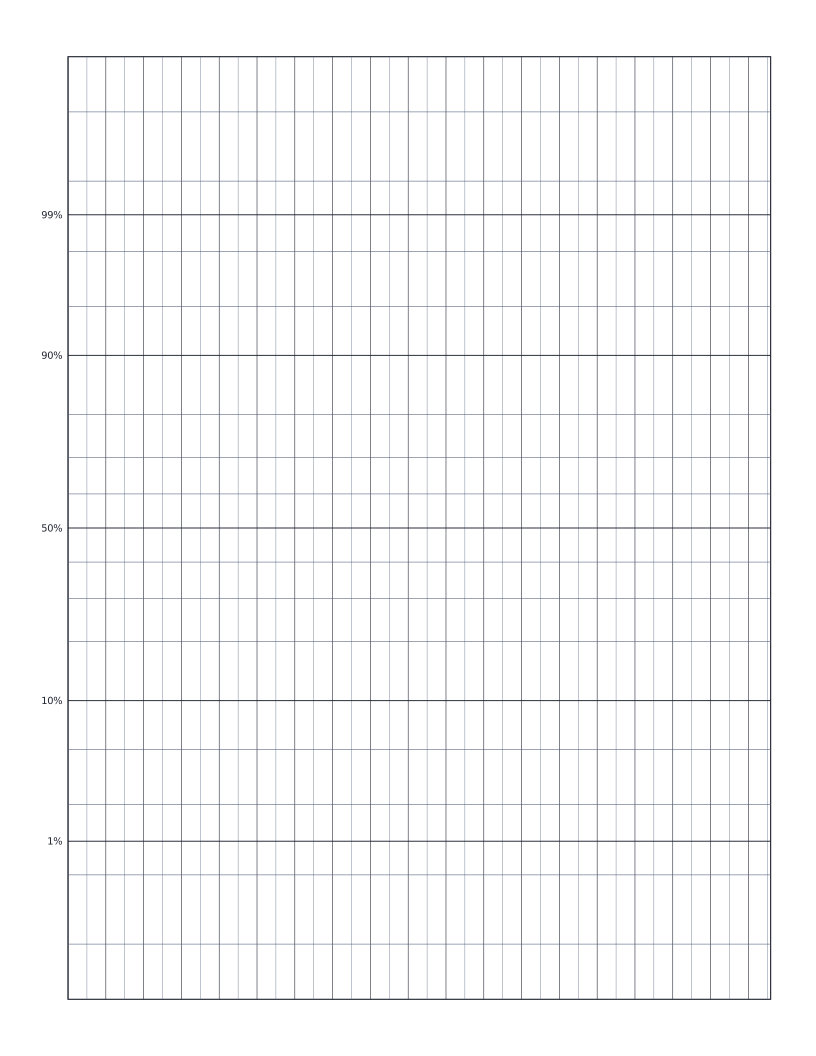
Normal Probability Paper
Normal probability paper: y-axis scaled by inverse normal CDF for plotting distribution data.
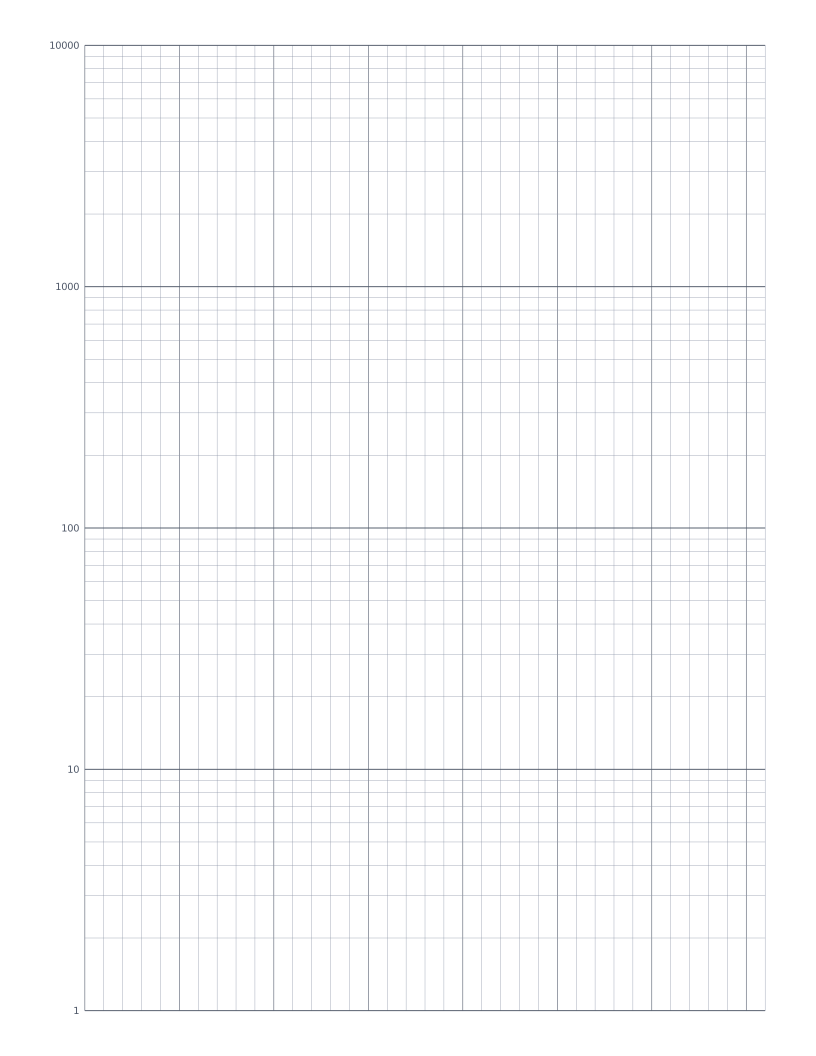
Semi-Log Graph Paper
Linear x-axis with a 4-decade logarithmic y-axis: the standard sheet for plotting exponentials and decay curves.