Live preview · Letter (8.5" × 11") · Gray lines
Log-Log Graph Paper
Log-log paper has logarithmic scales on both axes. Where semi-log paper straightens exponentials, log-log paper straightens power laws — any relationship of the form y = A·x^n becomes a straight line whose slope reveals the exponent n directly. That property makes it essential for any field where the variables themselves span many orders of magnitude.
Download generates a crisp vector PDF directly, no print dialog needed.
Choose a different paper size:
Choose a different line color:
Great for
- Power-law fitting (y = A·x^n) in physics, biology, allometry
- Frequency response (gain vs frequency, the format Bode plots evolved from)
- Particle-size distributions and grain-size analysis
- Stress-strain curves and material fatigue data
Log-Log Graph Paper at a glance
| What it is | Both axes logarithmic: the standard sheet for plotting power laws and frequency-response curves. |
|---|---|
| Category | Scientific |
| Paper sizes | Letter (8.5" × 11"), A4 (210 × 297 mm), 11" × 17", Legal (8.5" × 14"), A3 (297 × 420 mm), A2 (420 × 594 mm), Poster (18" × 24"), Movie Poster (27" × 40") |
| Line colors | Faint, Light, Gray, Dark, Black, Blue, Green (default: Gray) |
| Format | Vector PDF download at exact physical scale, or print directly from the browser |
| Price & license | Free. No signup or watermark. Printed sheets may be used for personal, classroom and commercial work. |
About log-log graph paper
Log-log paper is the workhorse format for power-law analysis. Take logs of both sides of y = A·x^n and you get log y = log A + n · log x — a straight line with slope n and intercept log A. That single algebraic identity is the reason every undergraduate physics lab, every materials engineer's notebook, and every Bode plot in electronics inherits this format. The visual diagnostic it offers is just as important as the fit. If your data forms a straight line on log-log paper, the underlying process is well-described by a power law and the slope is the exponent. If it curves, the model is wrong, and the way it curves tells you whether the exponent grows or shrinks with x. Famous results that were discovered first as straight lines on log-log paper include Kleiber's law (metabolic rate scales with body mass to the 3/4 power), Stevens' power law in psychophysics, and the various scaling exponents in critical phenomena.
What's on the page
A 3-decade horizontal axis crossed with a 4-decade vertical axis. Each decade contains nine minor lines (1, 2, 3, … 9 in log10 spacing) and one heavier line at the decade boundary. Major lines and decade labels run along the bottom (x-axis) and the left side (y-axis). You assign units when you label: the decades themselves are unitless. 3×4 gives a balanced page that covers most laboratory data without crowding either axis. If your data needs more horizontal range you can rotate the page (the renderer adapts).
How to use it well
Slope is the exponent, intercept is the prefactor
On log-log paper, a straight line has slope n equal to the power-law exponent. Measure rise-over-run in decades: if y goes up 2 decades while x goes up 1, the slope is 2 and the underlying law is y ∝ x². The y-intercept (where x = 1) gives the prefactor A directly.
Curvature is diagnostic
Concave-down means the effective exponent is decreasing with x (often saturation); concave-up means it's increasing (often a feedback or autocatalytic regime). Spot the curvature before you fit a model — the model should match the shape, not paper over it.
Anchor at the decade you care about
Like semi-log paper, the decade labels are unanchored. Decide what '1' on the x-axis means (1 mm, 1 Hz, 1 mg) before you plot, and label both axes with units. A log-log plot without unit anchors can be wildly misinterpreted.
Use it as a screening tool, not just a fit
Even before fitting a model, plotting raw data on log-log paper tells you whether a power law is plausible. Five minutes with paper and a pencil saves the embarrassment of fitting a power law to data that isn't power-law in the first place.
Common mistakes to avoid
- Plotting zero or negative values. The log of zero is negative infinity and the log of a negative is undefined. If your data crosses zero, log-log paper is the wrong tool; use linear paper or a different transformation.
- Reading off the slope without checking it's a single straight line. Real data often has different power-law regimes in different ranges — a straight-line eye fit across a piecewise relationship gives a meaningless 'average' exponent. Identify the regime first.
- Mistaking the decade spacing for linear. The visible interval between 1 and 2 is much wider than between 8 and 9 on the same decade. Reading values requires looking up the gridline label, not interpolating linearly.
FAQ, Log-Log Graph Paper
How is log-log different from [semi-log](/graph-paper/semi-log-graph-paper)?+
Semi-log has a linear x-axis and a log y-axis: it straightens exponentials (y = A·e^(kx)). Log-log has log scales on both axes: it straightens power laws (y = A·x^n). They look superficially similar but are not interchangeable — using the wrong format on the wrong data produces a misleading line with a meaningless slope.
Why 3 by 4 decades rather than equal?+
Most real-world data sets have more dynamic range on one axis than the other. A 3×4 layout suits the common case of a dependent variable spanning a wider range than the independent variable. If you need different dimensions (4×4 or 2×6), the same renderer can produce them; we may add variants if there's demand.
What's the relationship to a Bode plot?+
Magnitude Bode plots are essentially log-log paper with gain on the y-axis (in dB, which is itself a log scale) and frequency on the x-axis. The convention of measuring slope in 'decades per dB' or 'octaves per dB' comes directly from this paper format. Plot magnitudes on log-log paper and you get the same visual you'd see on a Bode chart.
Can I use it for non-power-law data?+
Yes, for visualisation. Any positive data set with a wide dynamic range is easier to read on log-log paper than on linear. The straight-line interpretation only applies if the data is genuinely power-law; otherwise the plot is just a wide-range visualisation, not a model fit.
What does a slope of zero mean?+
A horizontal line on log-log paper means y doesn't depend on x — a constant relationship. A slope of 1 means linear (y ∝ x); slope 2 means quadratic (y ∝ x²); slope -1 means inverse (y ∝ 1/x). The slope directly reads off the exponent of the power-law fit.
Printing tips for best results+
- 1. Click Print above. A new tab opens the template at exact size.
- 2. The print dialog appears automatically. Set Scale to 100%. Never "Fit to page", which silently shrinks every cell.
- 3. Set Margins to None or Minimum so the grid reaches the page edge.
- 4. For a PDF, click Download instead. It generates a vector PDF directly without going through the printer driver.
You might also like
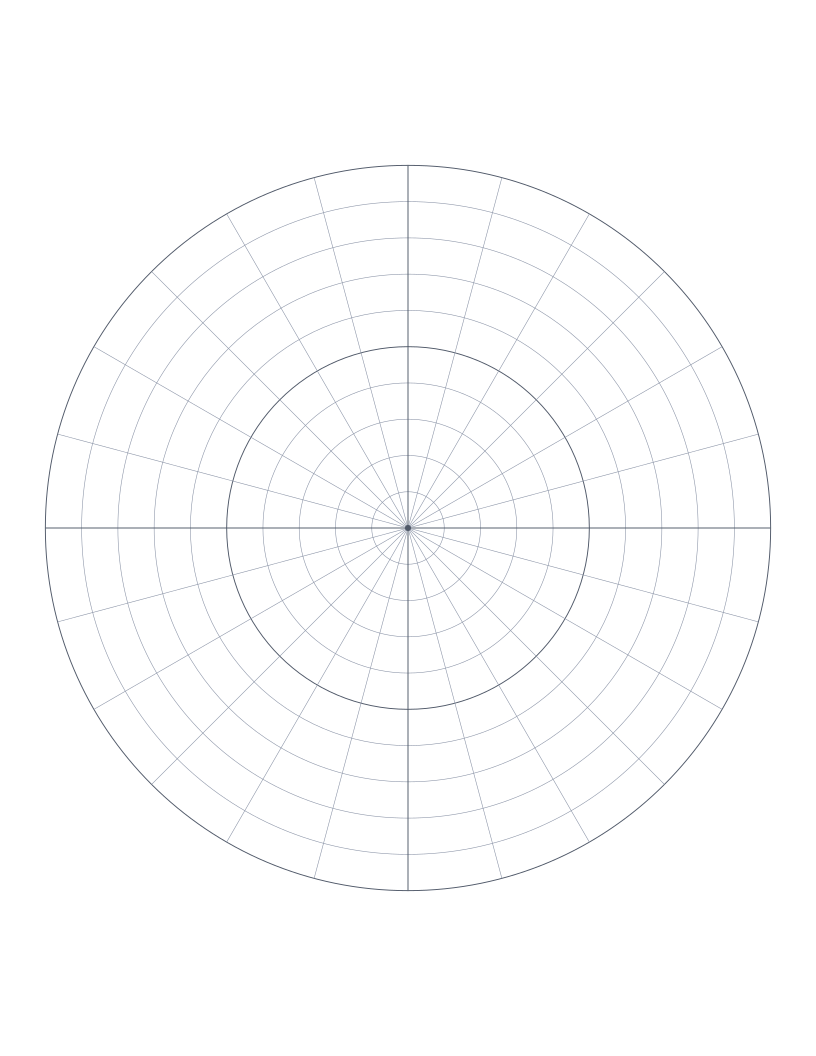
Polar Graph Paper
Concentric circles with radial spokes: for polar coordinates, vector diagrams and circular design.
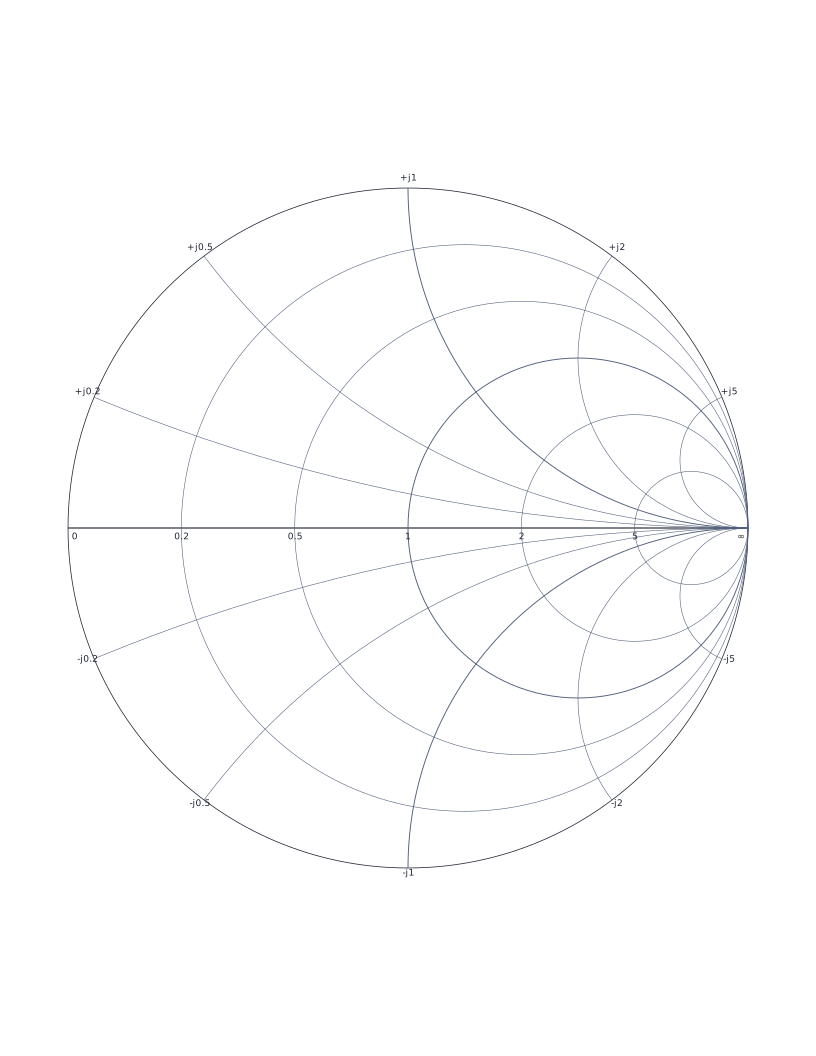
Smith Chart
Classic Smith chart for transmission line impedance matching and RF engineering.
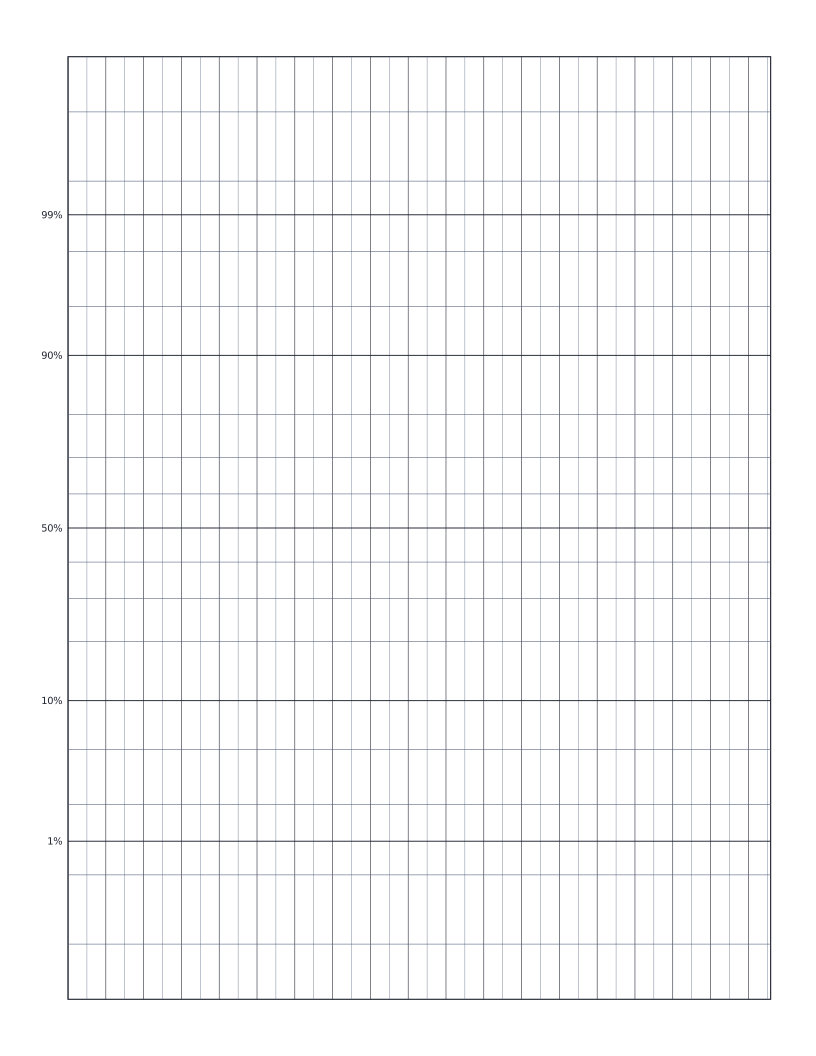
Normal Probability Paper
Normal probability paper: y-axis scaled by inverse normal CDF for plotting distribution data.
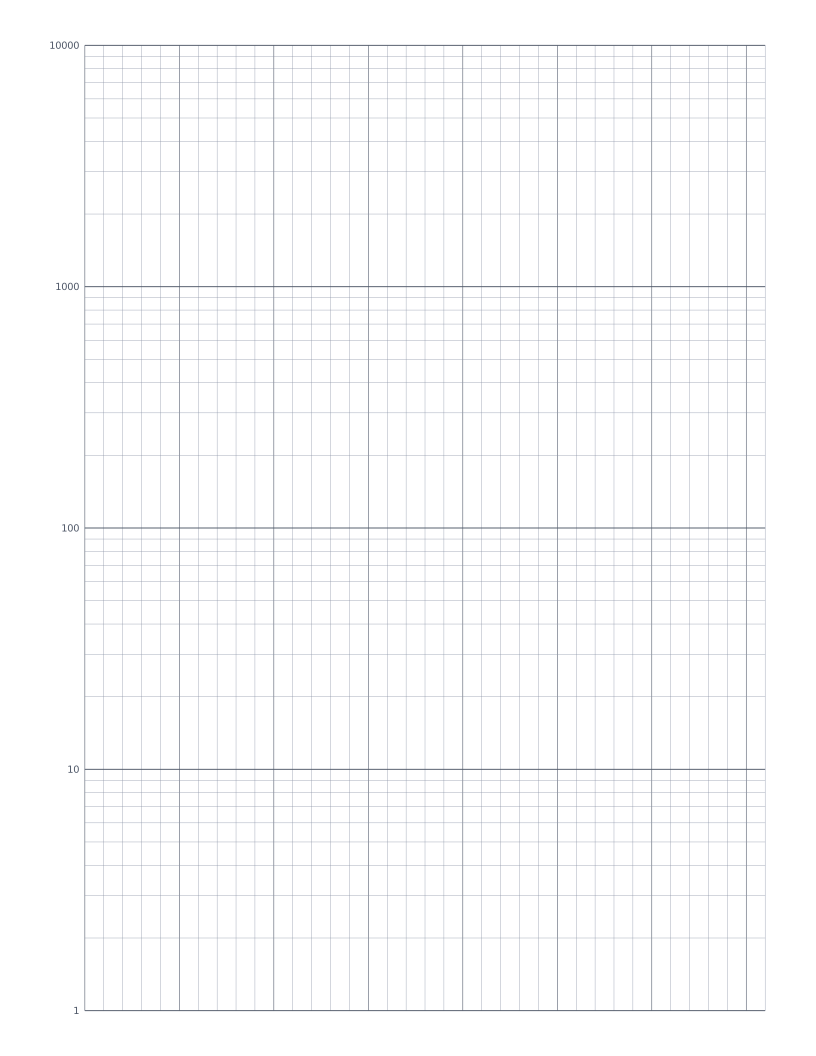
Semi-Log Graph Paper
Linear x-axis with a 4-decade logarithmic y-axis: the standard sheet for plotting exponentials and decay curves.