Live preview · Letter (8.5" × 11") · Gray lines
Ternary Plot Paper
A ternary plot, also called a triangular plot or simplex chart, displays the relative proportions of three components that sum to 100%. The equilateral triangle has gridlines parallel to each side at 10% intervals, so any composition (a, b, c) where a + b + c = 100% maps to a single point inside the triangle.
Download generates a crisp vector PDF directly, no print dialog needed.
Choose a different paper size:
Choose a different line color:
Great for
- Phase diagrams in metallurgy and chemistry (three-component alloys, solutions)
- Soil classification (sand / silt / clay percentages)
- Color theory (additive RGB or subtractive CMY blends)
- Voting and demographic data (three-party shares, three-group surveys)
Ternary Plot Paper at a glance
| What it is | Equilateral triangle with three sets of grid lines: the standard format for plotting three-component compositions in chemistry, metallurgy and soil science. |
|---|---|
| Category | Scientific |
| Paper sizes | Letter (8.5" × 11"), A4 (210 × 297 mm), 11" × 17", Legal (8.5" × 14"), A3 (297 × 420 mm), A2 (420 × 594 mm), Poster (18" × 24"), Movie Poster (27" × 40") |
| Line colors | Faint, Light, Gray, Dark, Black, Blue, Green (default: Gray) |
| Format | Vector PDF download at exact physical scale, or print directly from the browser |
| Price & license | Free. No signup or watermark. Printed sheets may be used for personal, classroom and commercial work. |
About ternary plot paper
The ternary plot solves a specific visualisation problem: how do you show three quantities that sum to a fixed total on a 2D page? A bar chart shows three values but loses the constraint that they add to 100%. A pie chart shows the constraint but only for one row of data — a hundred rows give you a hundred pies. The ternary plot collapses three constrained values into a single point in an equilateral triangle, and the resulting plot can show hundreds of compositions at once on a single page. Each vertex represents 100% of one component; the opposite side represents 0% of that component. As you move from a vertex toward the opposite side, that component's percentage decreases linearly. The format is the standard in any field where three-component compositions matter: phase diagrams in materials science, soil-texture classification, three-party political vote shares, color-blend theory. The convention dates from at least Willard Gibbs' work in chemical thermodynamics in the 1870s, where ternary diagrams became the standard tool for representing phase equilibria; soil scientists picked up the format in the early 20th century for the USDA soil triangle, which is still the international classification standard.
What's on the page
An equilateral triangle filling the printable area, with gridlines parallel to each side at 10% intervals (heavier accent lines at every 50% mark) and finer subdivisions at every 10%. Vertices are labelled A, B and C; you assign component names when you use the paper. The grid is centred horizontally and the triangle sits within the page's usable area without crowding the edges.
How to use it well
Read percentages along the parallel gridlines
To read the percentage of component A at a point, find the gridline that runs parallel to the side opposite vertex A and passes through your point. The percentage of A is given by where that gridline meets the A-axis edge. The same trick works for B and C. The three percentages always sum to 100%.
Choose vertex order to match convention in your field
Soil scientists put clay at the top vertex, sand at the bottom-right, silt at the bottom-left. Metallurgists vary by alloy system. Pick the convention used in your discipline's textbooks; consistency matters more than which assignment is 'right'.
Mark compositions before plotting curves
For phase diagrams, plot the key compositions (eutectics, peritectics, pure-phase boundaries) as labelled dots before drawing any curves through them. Curves drawn through dots look intentional; curves drawn freehand sometimes drift through compositions that don't exist in the real system.
Two ternary plots can show a four-component system
If you fix one component and vary the others, you get a ternary plot in three remaining components. Stacking several such plots (each at a different fixed value of the fourth) is a common way to visualise four-component systems where a 3D representation would be illegible.
Common mistakes to avoid
- Misreading the gridlines. The lines parallel to the bottom side give percentages of the top-vertex component (not the bottom-vertex). Beginners often read the wrong axis; check by verifying that all three percentages sum to 100% before trusting a reading.
- Forgetting that values must sum to 100%. A ternary plot only works when the three components add to a fixed total. If you have absolute values (not percentages), normalise them before plotting. Two compositions with the same ratios but different totals plot to the same point.
- Using a ternary plot for unconstrained three-variable data. If your three variables don't sum to a fixed total, a ternary plot is misleading. Use 3D plots, parallel coordinates, or multiple bivariate plots instead.
FAQ, Ternary Plot Paper
What's the difference between a ternary plot and a [triangular graph paper](/graph-paper/triangular-graph-paper)?+
Triangular graph paper is a general-purpose grid of equilateral triangles tiling the page — useful for isometric drawing, certain design layouts and triangular pixel art. A ternary plot is a single large equilateral triangle with axes labelled in percentages — used specifically for plotting three-component compositions. Different formats, different purposes.
Why are the vertices at 100% and the opposite sides at 0%?+
It's the geometric consequence of the constraint A + B + C = 100%. Each vertex is the point where one component is 100% and the others are 0%; the opposite side is the locus of points where that component is 0% and the other two share the full 100% between them. The linear gridlines between are the loci of constant percentage for each component.
What does a curve on a ternary plot represent?+
Depends on context. In phase diagrams, a curve typically represents a boundary between phases (where two phases coexist). In soil classification, the bounded regions are named soil types (sandy loam, clay loam, silty clay). The curves themselves are domain-specific; the ternary plot is the canvas, not the content.
Can I use this for two-component or four-component systems?+
No. Two components fit on a single line (binary phase diagram); four or more components require higher-dimensional projections (tetrahedron for four; you'd need stacked or rotated representations). The ternary plot is specifically for three-component compositions.
What's a 'eutectic point' on a ternary plot?+
The composition at which three phases coexist at the lowest melting temperature in the system. On a ternary phase diagram, it's a single point — usually a key feature of any alloy or solution system being studied. Find the eutectic, label it, and the rest of the phase diagram organises around it.
Printing tips for best results+
- 1. Click Print above. A new tab opens the template at exact size.
- 2. The print dialog appears automatically. Set Scale to 100%. Never "Fit to page", which silently shrinks every cell.
- 3. Set Margins to None or Minimum so the grid reaches the page edge.
- 4. For a PDF, click Download instead. It generates a vector PDF directly without going through the printer driver.
You might also like
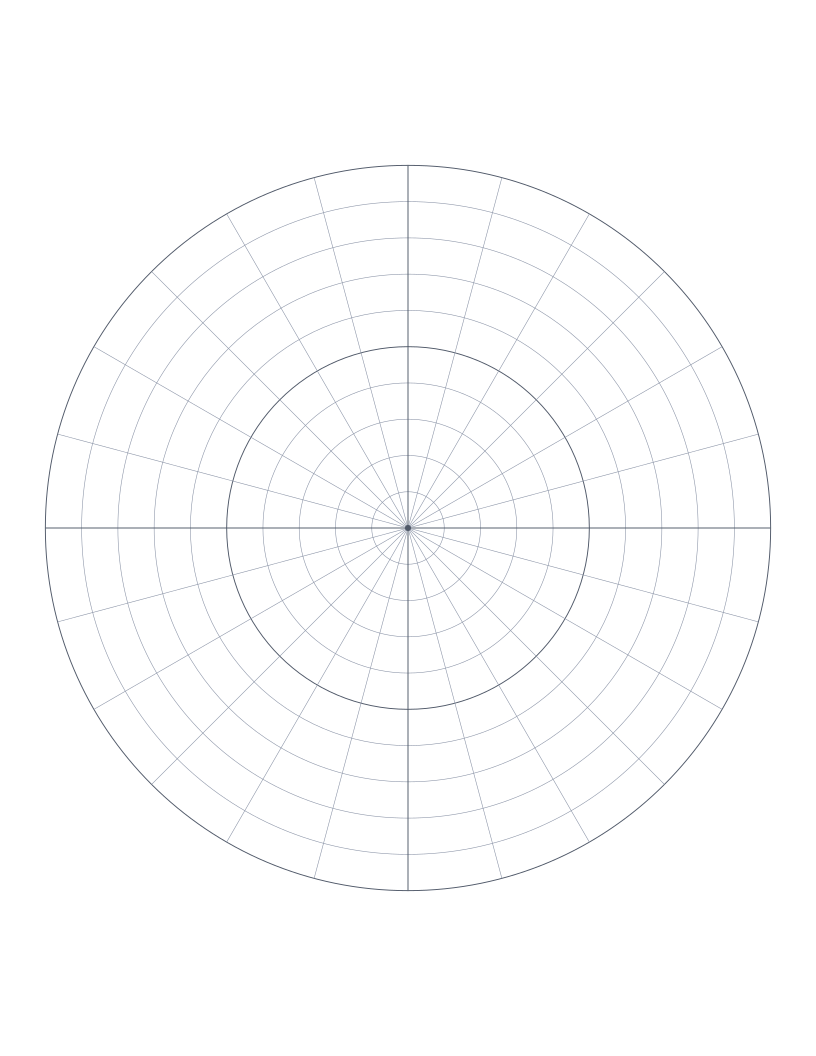
Polar Graph Paper
Concentric circles with radial spokes: for polar coordinates, vector diagrams and circular design.
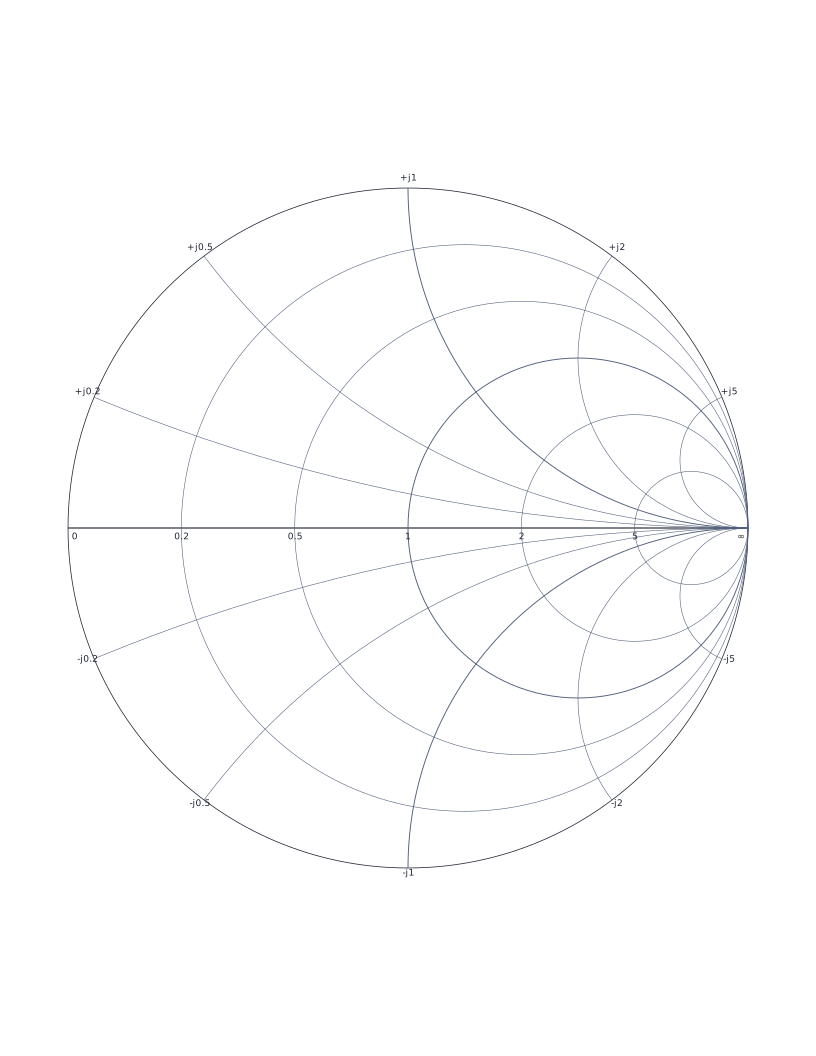
Smith Chart
Classic Smith chart for transmission line impedance matching and RF engineering.
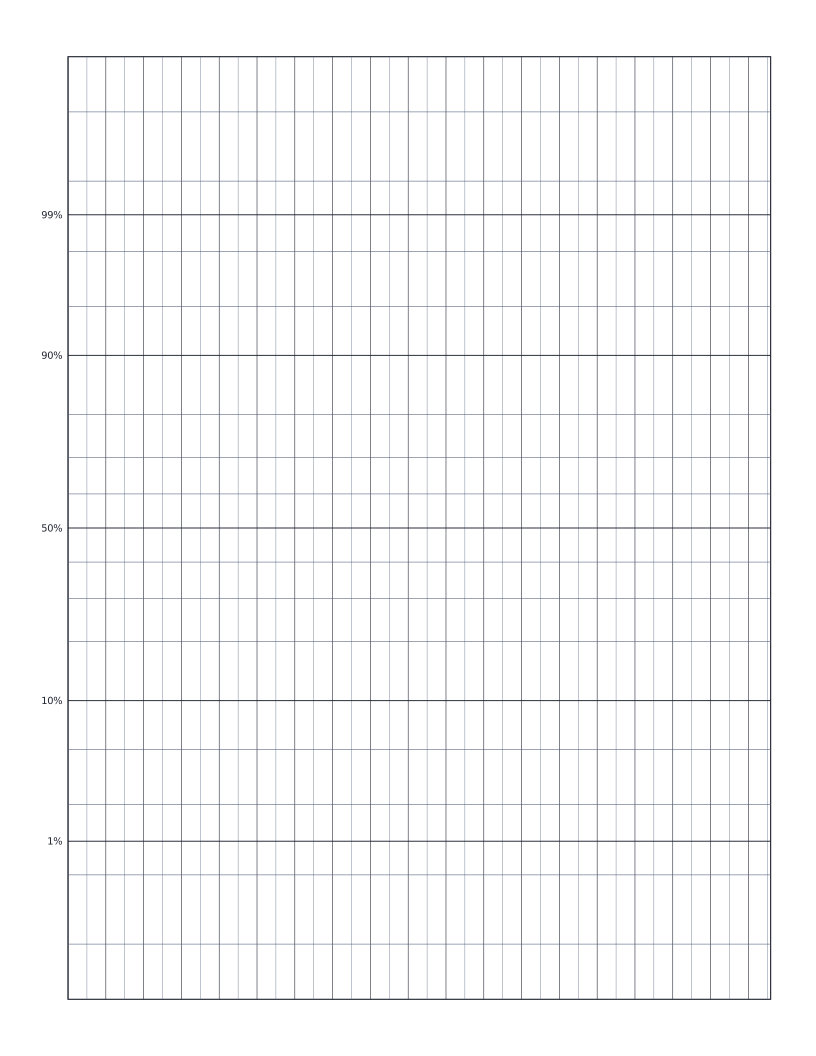
Normal Probability Paper
Normal probability paper: y-axis scaled by inverse normal CDF for plotting distribution data.
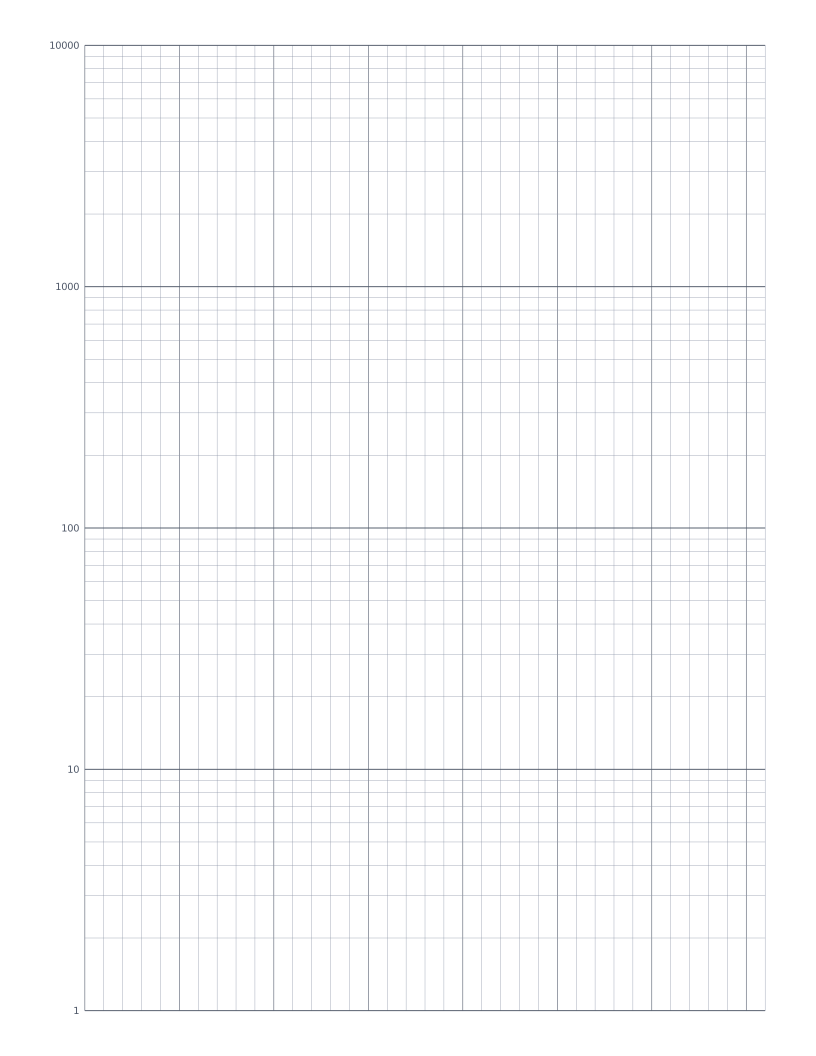
Semi-Log Graph Paper
Linear x-axis with a 4-decade logarithmic y-axis: the standard sheet for plotting exponentials and decay curves.