Live preview · Letter (8.5" × 11") · Gray lines
Nyquist Plot Paper
Nyquist plot paper is a Cartesian complex plane with a prominent unit circle, smaller concentric circles for magnitude reference and radial lines at 15° increments for phase reading. The standard surface for sketching the Nyquist contour of a transfer function and applying the Nyquist stability criterion.
Download generates a crisp vector PDF directly, no print dialog needed.
Choose a different paper size:
Choose a different line color:
Great for
- Sketching the Nyquist contour of a linear control system
- Applying the Nyquist stability criterion (counting encirclements of –1)
- Reading gain margin and phase margin graphically
- Visualising complex impedance in AC circuit analysis
Nyquist Plot Paper at a glance
| What it is | Complex plane with unit circle and radial phase lines: the standard format for plotting Nyquist contours and frequency response in control systems. |
|---|---|
| Category | Scientific |
| Paper sizes | Letter (8.5" × 11"), A4 (210 × 297 mm), 11" × 17", Legal (8.5" × 14"), A3 (297 × 420 mm), A2 (420 × 594 mm), Poster (18" × 24"), Movie Poster (27" × 40") |
| Line colors | Faint, Light, Gray, Dark, Black, Blue, Green (default: Gray) |
| Format | Vector PDF download at exact physical scale, or print directly from the browser |
| Price & license | Free. No signup or watermark. Printed sheets may be used for personal, classroom and commercial work. |
About nyquist plot paper
The Nyquist plot is named for Harry Nyquist, who in 1932 introduced the eponymous stability criterion: a feedback control system is stable if and only if the Nyquist contour of its open-loop transfer function encircles the point –1 a specific number of times (the number depending on the system's open-loop pole count). The visualisation is direct: plot the complex value G(jω) for ω ranging from 0 to infinity (and back along the negative real axis for the full contour), and count how many times the resulting curve wraps around –1. The same plot reveals gain margin (how much you can scale the gain before the contour passes through –1) and phase margin (how close the contour comes to the negative real axis at unit magnitude) — both critical for designing stable control loops. The format remains the standard teaching tool in control theory because the geometric interpretation of stability is genuinely insightful: 'don't encircle –1' is a single visual rule that subsumes a great deal of algebraic manipulation. The paper provides the Cartesian grid (so you can read real and imaginary values at any point) plus the concentric circles (so you can quickly read magnitudes) plus the radial lines (for phase reading).
What's on the page
A Cartesian grid centred on the origin, with real on the horizontal axis and imaginary on the vertical, both running from –5 to +5 in unit steps. Concentric circles at unit radii 1, 2, 3, 4 and 5 — the unit circle (radius 1) drawn heavier for emphasis. Radial lines every 15° from the origin to the outer circle. Tick labels on the real axis; axis labels 'Re' and 'Im' at the ends of the axes.
How to use it well
Plot a few key frequencies first
Before sketching the full Nyquist contour, evaluate G(jω) at ω = 0 (the DC gain on the real axis), ω = ∞ (the high-frequency limit), and the corner frequencies of any poles or zeros. Plot those points first, then sketch the curve connecting them.
Check the –1 encirclement count
The Nyquist criterion is: number of encirclements of –1 equals (closed-loop unstable poles) – (open-loop unstable poles). For most stable systems, you want zero encirclements. Trace your contour with a finger; count how many times it goes around the point (–1, 0).
Read gain margin off the negative real axis
Where the contour crosses the negative real axis (between –1 and the origin), the distance to –1 is the gain margin. If the crossing is at –0.5, the gain margin is 2 (you could double the open-loop gain before instability). If it crosses past –1, the system is already unstable.
Phase margin is read at the unit circle
Find where the contour crosses the unit circle. The angle from the negative real axis to that crossing point is the phase margin. A larger phase margin means more damping. Typical control-loop designs target 45–60° of phase margin.
Common mistakes to avoid
- Forgetting the symmetric lower half. The Nyquist contour for a real system is symmetric about the real axis: the upper half (positive frequencies) and the lower half (negative frequencies) are mirror images. Sketching only the upper half misses the encirclement geometry; you need both halves to count encirclements correctly.
- Confusing 'encircle' with 'pass near'. The criterion is about how many times the contour winds around –1, not how close it gets. A contour that wiggles near –1 without going around it doesn't count as an encirclement. Count using the winding number, not visual proximity.
- Using a linear scale for highly damped systems. For systems with response magnitudes spanning many orders, the linear Nyquist plot can be hard to read (small details near the origin disappear). Logarithmic Nyquist plots (rare but useful) handle this; for typical undergrad systems, the linear version on this paper works fine.
FAQ, Nyquist Plot Paper
What's the difference between Nyquist and [Bode plots](/graph-paper/bode-plot-paper)?+
Both display frequency response, but in different coordinates. Bode plots show magnitude (dB) and phase (degrees) as separate plots, each against log frequency. Nyquist shows G(jω) as a single curve in the complex plane, with frequency varying along the curve. Bode plots are more useful for design (you can see the effect of each pole/zero); Nyquist is more useful for stability (encirclement counting).
How does this relate to the [Smith chart](/graph-paper/smith-chart)?+
The Smith chart is a specialised polar plot for impedance and reflection coefficient in RF engineering, with curved lines for constant resistance and reactance. The Nyquist plot is a general Cartesian complex plane with concentric circles. Different applications: Smith is for RF impedance matching, Nyquist is for control-loop stability.
Why is the unit circle drawn heavier?+
Because it represents the gain margin reference: where the open-loop magnitude equals 1. The point (–1, 0) on this circle is the stability boundary. The unit circle is the most-read reference on the plot, so it's emphasised visually.
Can I use this for AC impedance plots (Nyquist impedance plot)?+
Yes — electrochemists use this format for electrochemical impedance spectroscopy (EIS), where Z' is plotted against –Z''. The graph paper layout is identical, though EIS conventions differ slightly: the imaginary axis is plotted downward (positive imaginary = below the real axis) because impedance imaginary parts are negative in passive systems. You can flip the y-axis interpretation as needed.
Why ±5 instead of a wider range?+
Most undergraduate control problems have Nyquist contours that fit comfortably within ±5 on both axes. Larger ranges compress the unit circle into a small dot in the centre, hiding the stability geometry. If your system has very large gain, scale down by a known factor before plotting.
Printing tips for best results+
- 1. Click Print above. A new tab opens the template at exact size.
- 2. The print dialog appears automatically. Set Scale to 100%. Never "Fit to page", which silently shrinks every cell.
- 3. Set Margins to None or Minimum so the grid reaches the page edge.
- 4. For a PDF, click Download instead. It generates a vector PDF directly without going through the printer driver.
You might also like
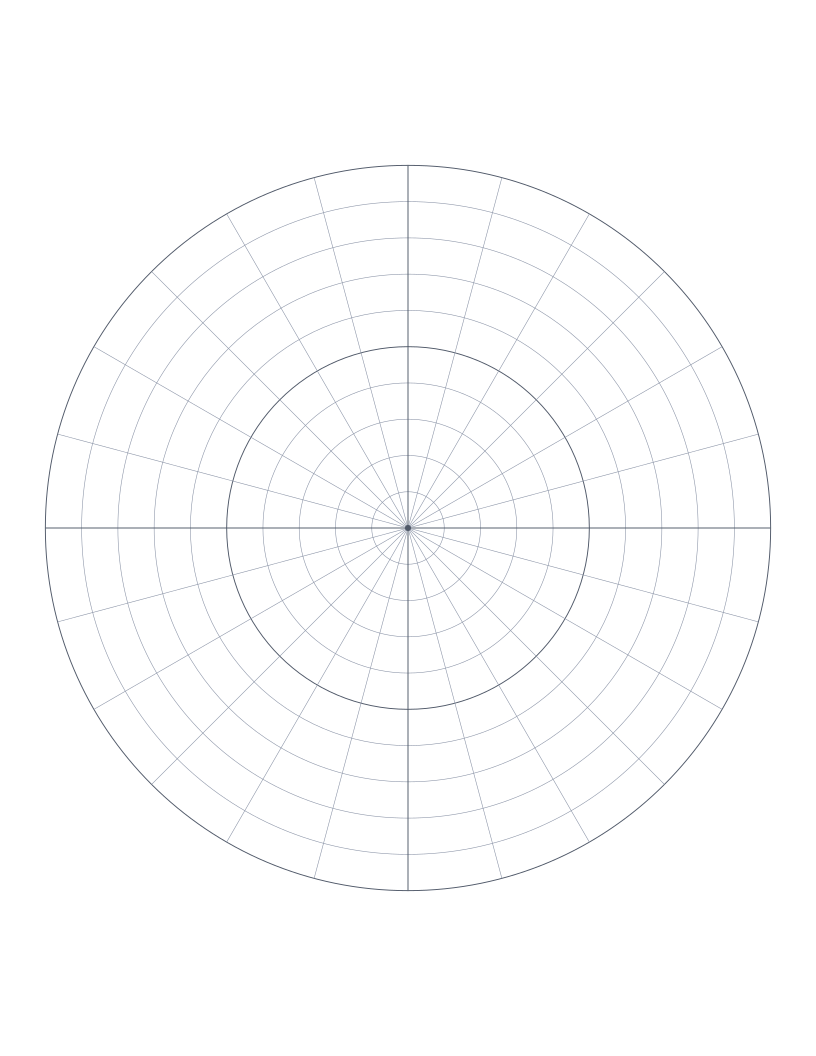
Polar Graph Paper
Concentric circles with radial spokes: for polar coordinates, vector diagrams and circular design.
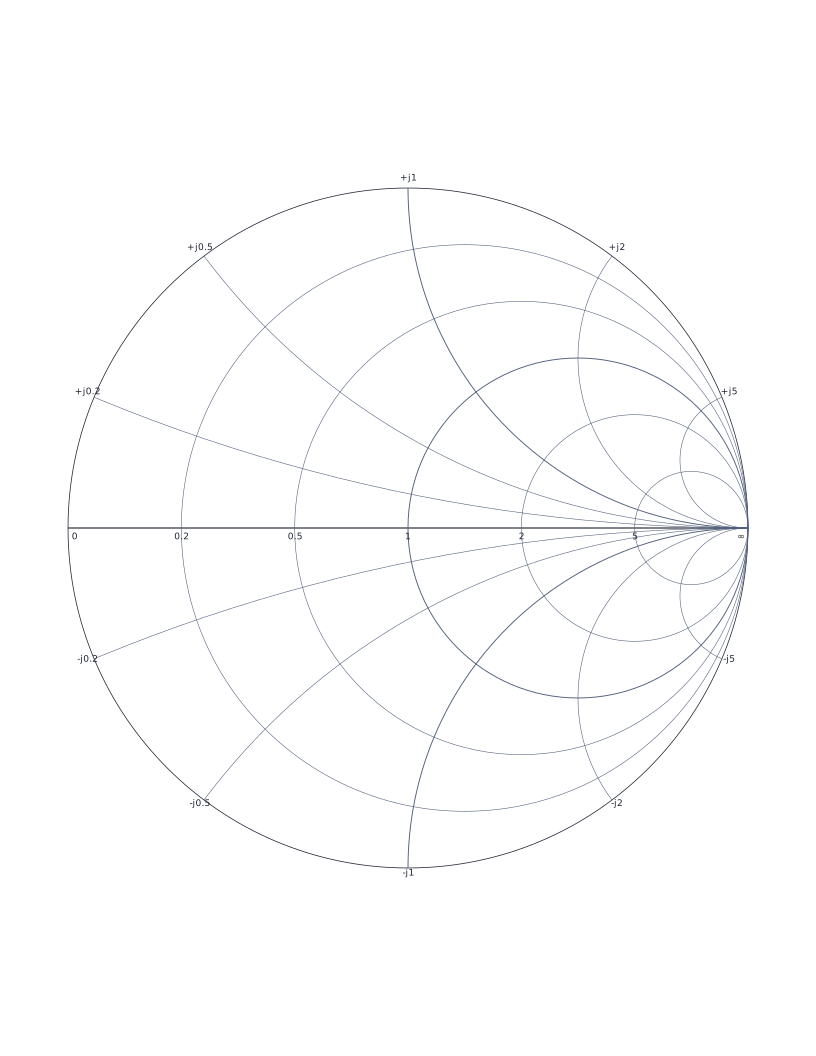
Smith Chart
Classic Smith chart for transmission line impedance matching and RF engineering.
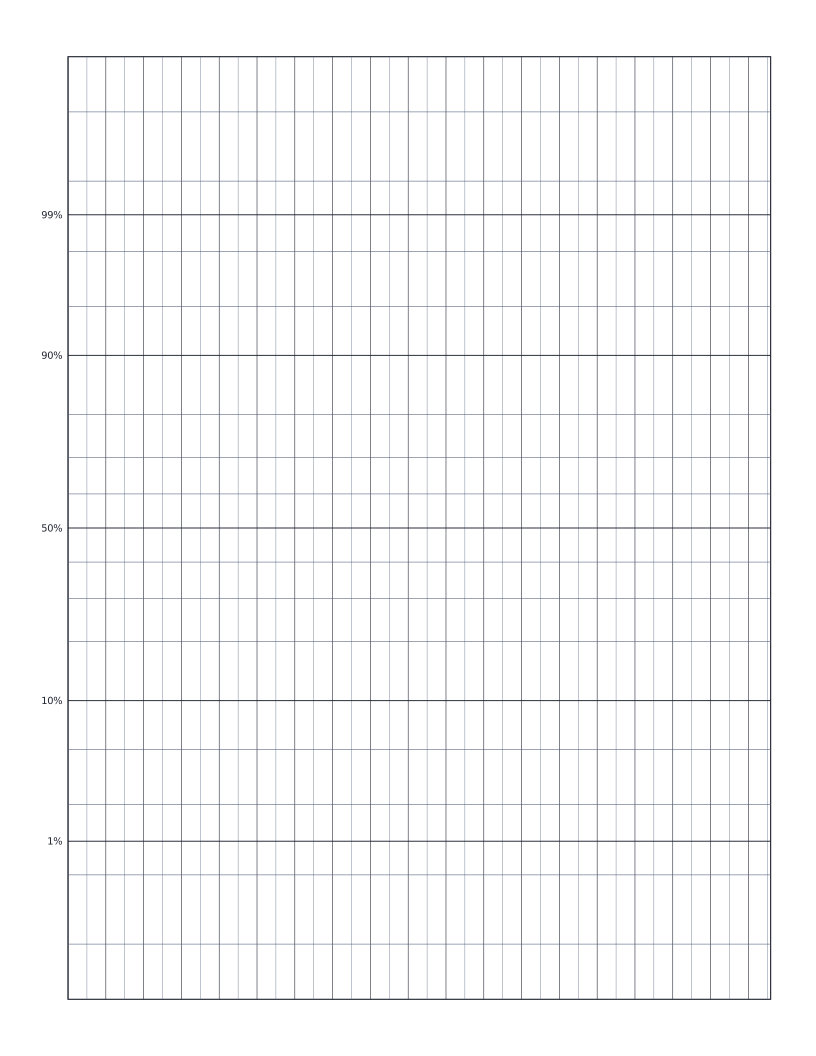
Normal Probability Paper
Normal probability paper: y-axis scaled by inverse normal CDF for plotting distribution data.
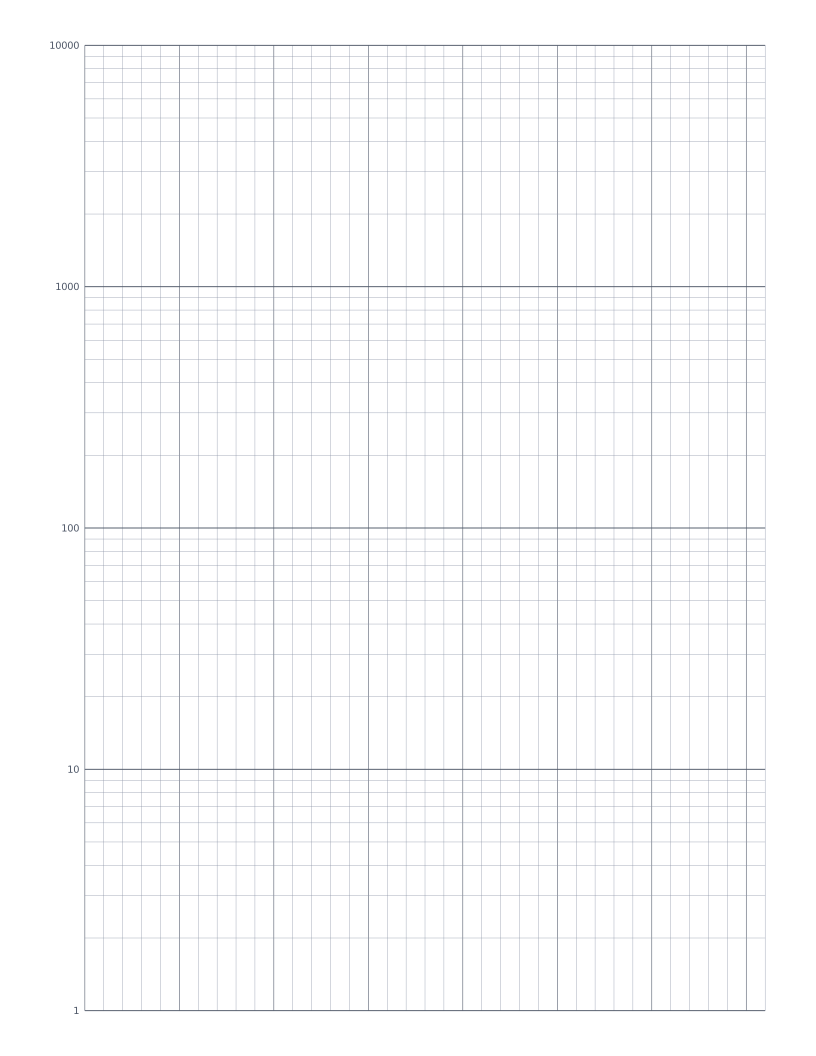
Semi-Log Graph Paper
Linear x-axis with a 4-decade logarithmic y-axis: the standard sheet for plotting exponentials and decay curves.