Live preview · Letter (8.5" × 11") · Gray lines
D'Nealian Handwriting Paper
Three-line handwriting paper at the row spacing used in classrooms that teach D'Nealian script. The format is the same three-line scaffold used in most US elementary handwriting instruction — topline, dashed midline, baseline — sized at a 20 mm row pitch that matches typical D'Nealian workbook spacing.
Download generates a crisp vector PDF directly, no print dialog needed.
Choose a different paper size:
Choose a different line color:
Great for
- K–2 D'Nealian handwriting instruction
- Practice sheets for parents using D'Nealian curricula
- Special-education handwriting remediation
- Pre-cursive practice (D'Nealian is designed as a bridge to cursive)
D'Nealian Handwriting Paper at a glance
| What it is | Three-line handwriting paper sized for D'Nealian script: slightly tighter rows than Zaner-Bloser, matched to the curved D'Nealian letter forms. |
|---|---|
| Category | Writing & Notes |
| Paper sizes | Letter (8.5" × 11"), A4 (210 × 297 mm), 11" × 17", Legal (8.5" × 14"), A3 (297 × 420 mm), A2 (420 × 594 mm), Poster (18" × 24"), Movie Poster (27" × 40") |
| Line colors | Faint, Light, Gray, Dark, Black, Blue, Green (default: Gray) |
| Format | Vector PDF download at exact physical scale, or print directly from the browser |
| Price & license | Free. No signup or watermark. Printed sheets may be used for personal, classroom and commercial work. |
About d'nealian handwriting paper
D'Nealian is a handwriting style developed by Donald Thurber in the late 1970s as a transitional script intended to bridge the gap between print and cursive. Where the more traditional Zaner-Bloser style uses fully separated, mostly straight strokes, D'Nealian letters are slightly slanted with curved tails on most lowercase letters. Those tails carry over almost directly into the connections of cursive writing, so children who learn D'Nealian print can transition to D'Nealian cursive without retraining the underlying letter shapes. The system has been adopted across a substantial fraction of US elementary schools since its introduction, particularly in districts that found the Zaner-Bloser-to-cursive transition difficult. The paper itself is essentially the same three-line scaffold any handwriting curriculum uses, but at a slightly tighter row pitch — typical D'Nealian workbooks use ~20 mm rows rather than the ~22 mm rows of Zaner-Bloser — because the slanted letter forms read more clearly when packed slightly denser.
What's on the page
Stacked three-line rows at 20 mm pitch. Each row consists of a solid topline (the ascender ceiling), a dashed midline (the x-height boundary, drawn lighter and dashed), and a solid baseline. The space between baseline of one row and topline of the next is the descender zone — letters with descenders (g, j, p, q, y) dip into this gap. Lines run from the left margin to the right margin so children can practice from the start of a line without worrying about indentation.
How to use it well
The dashed line is the x-height boundary
Lowercase letters without ascenders or descenders (a, c, e, m, n, o, s, u, v, w, x) sit between the dashed midline and the baseline. The midline is where the letter 'tops out'. Reinforcing this to children is the single most useful piece of handwriting instruction.
Tails curve into the next letter
D'Nealian's defining feature is the curved exit stroke on most lowercase letters. The tail of an 'a' curls slightly rightward and upward, anticipating the connection to the next letter. Even in print, students practice this curve — it becomes the link stroke in cursive.
Use the descender space deliberately
Letters like g, p, q, y have tails that drop below the baseline into the gap between rows. Make sure the descender doesn't crash into the topline of the next row down — there should be visible white space between the bottom of the descender and the topline below.
Slight slant, not vertical
D'Nealian script has a subtle right-leaning slant (about 3–5 degrees). On the paper, the lines stay horizontal; the slant comes from the angle at which the child writes the letters. A common mistake is to over-slant or write straight up; both look wrong by D'Nealian's conventions.
Common mistakes to avoid
- Confusing D'Nealian and Zaner-Bloser. They look superficially similar but have different letter forms — D'Nealian's 'a' has a curved tail, Zaner-Bloser's is straight. Make sure the paper matches the curriculum the school is teaching.
- Treating the midline as optional. Children who ignore the midline write letters of inconsistent height (the x-height of one letter towering over the next). The dashed line exists to make that boundary explicit; reinforce it actively.
- Using the wrong row size. K–1 students benefit from tall rows (22+ mm) for early control; grade 2 onwards they're ready for the standard 20 mm pitch on this template. Going smaller (16 mm or less) too early frustrates motor development.
FAQ, D'Nealian Handwriting Paper
What's the difference between D'Nealian and [Zaner-Bloser](/graph-paper/zaner-bloser-handwriting-paper)?+
Both are US handwriting curricula with three-line paper. Zaner-Bloser uses fully separated, mostly straight print letters that transition into a separate cursive style later. D'Nealian uses slightly slanted print letters with curved tails that are designed to flow naturally into cursive without retraining. Districts pick one curriculum and stick with it; the paper formats are similar but the letter shapes children practice differ.
What row size matches a D'Nealian workbook?+
Most D'Nealian workbooks use a row pitch of roughly 20 mm (about 13/16 inch). The exact dimensions vary by grade — K rows are taller (22–25 mm), grade 2+ rows are smaller (16–18 mm). The 20 mm pitch here is a sensible middle ground that works for grade 1 and early grade 2.
Can adults use this for handwriting practice?+
Yes. Adult handwriting remediation often uses the same three-line scaffold to retrain letter sizing. The D'Nealian style produces a readable, slightly slanted hand that many adults find more attractive than block print.
Do I need this if my school teaches D'Nealian?+
Not strictly — schools usually supply their own paper. But for home practice, homework, or supplementary worksheets, having a matching paper at home makes the at-school / at-home practice consistent. Inconsistency in row size and scaffolding is a small but real obstacle to children's handwriting development.
What about cursive practice?+
This template is for print/manuscript practice. D'Nealian cursive uses a similar three-line scaffold, but the letter forms connect into continuous strokes — the paper is the same, the writing changes. For pure cursive practice, the three-line format here still works.
Printing tips for best results+
- 1. Click Print above. A new tab opens the template at exact size.
- 2. The print dialog appears automatically. Set Scale to 100%. Never "Fit to page", which silently shrinks every cell.
- 3. Set Margins to None or Minimum so the grid reaches the page edge.
- 4. For a PDF, click Download instead. It generates a vector PDF directly without going through the printer driver.
You might also like
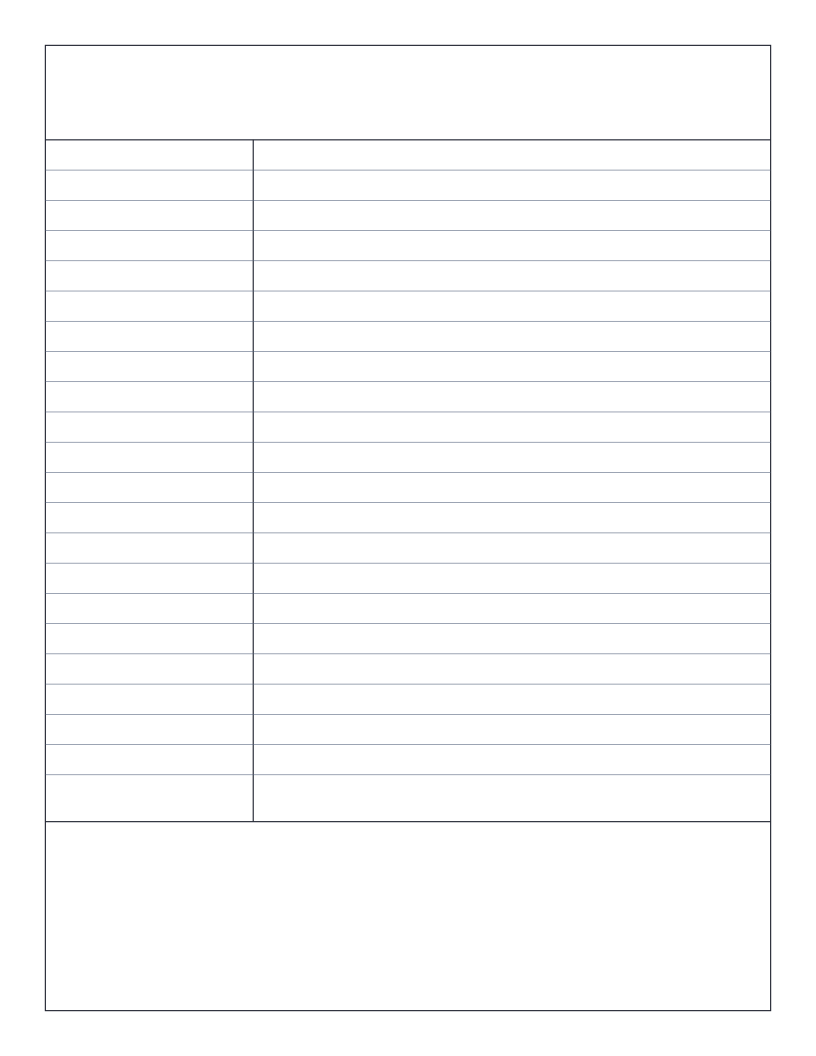
Cornell Notes Paper
The famous Cornell note-taking layout: cue column, main notes and summary band.
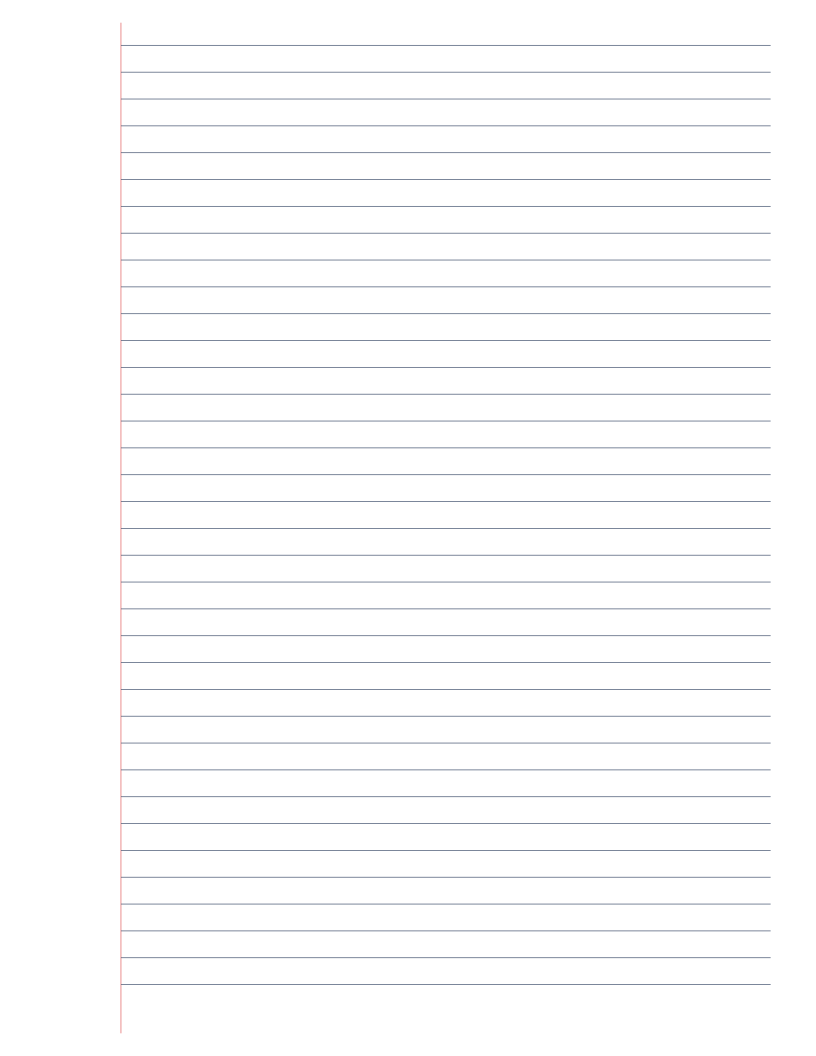
Lined Paper (College Ruled)
Classic college-ruled lined paper: 7.1mm line spacing with a red margin.
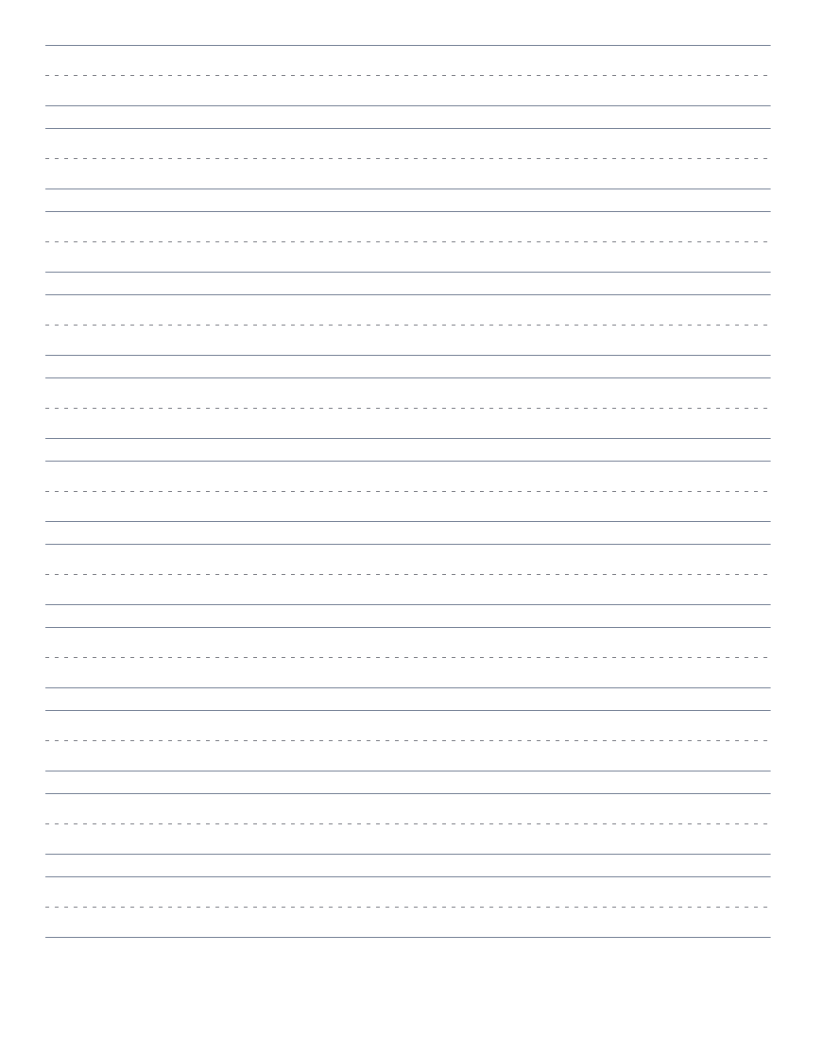
Handwriting Practice Paper
Three-line handwriting paper with dashed midline: for primary writing practice.
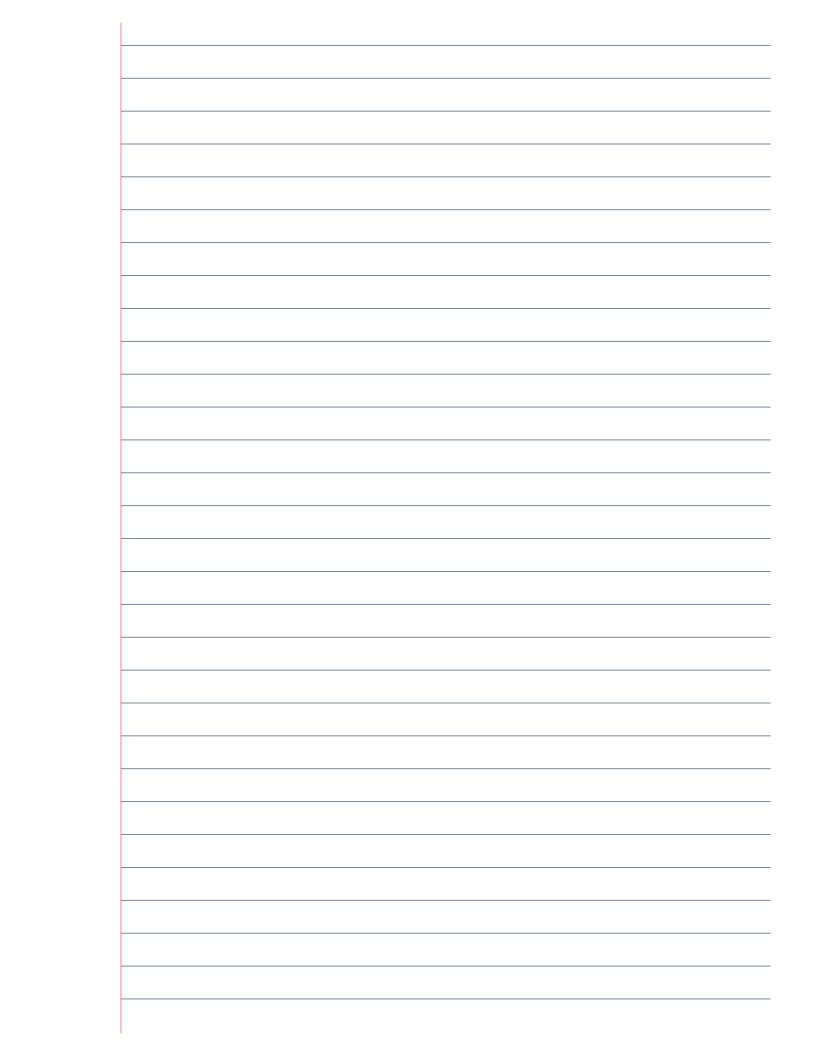
Wide Ruled Lined Paper
Classic wide-ruled lined paper: 8.7mm line spacing, the US elementary school standard.