Live preview · Letter (8.5" × 11") · Dark lines
Handwriting Practice Paper
Three-line handwriting paper anchors every letter with a top line, dashed midline, and solid baseline. The midline tells learners where lowercase letters reach to ('x-height'); the baseline tells them where every letter sits.
Download generates a crisp vector PDF directly, no print dialog needed.
Choose a different paper size:
Choose a different line color:
Great for
- Primary school print and manuscript handwriting
- ESL / EFL handwriting and letter-formation practice
- Cursive and joined-up writing introduction
- Occupational therapy for fine motor development
Handwriting Practice Paper at a glance
| What it is | Three-line handwriting paper with dashed midline: for primary writing practice. |
|---|---|
| Category | Writing & Notes |
| Paper sizes | Letter (8.5" × 11"), A4 (210 × 297 mm), 11" × 17", Legal (8.5" × 14"), A3 (297 × 420 mm), A2 (420 × 594 mm), Poster (18" × 24"), Movie Poster (27" × 40") |
| Line colors | Faint, Light, Gray, Dark, Black, Blue, Green (default: Dark) |
| Format | Vector PDF download at exact physical scale, or print directly from the browser |
| Price & license | Free. No signup or watermark. Printed sheets may be used for personal, classroom and commercial work. |
About handwriting practice paper
Three-line handwriting paper is the scaffolding under almost every Western handwriting curriculum. The convention dates to the late 19th century when American educators standardised on a layout that explicitly marked the two heights letters need to navigate: tall letters (b, d, f, h, k, l, t, plus all uppercase) reach the top line, short letters (a, c, e, m, n, o, r, s, u, v, w, x, z) reach the dashed midline, and every letter (including the descenders g, j, p, q, y) sits on the baseline. The midline being dashed rather than solid is deliberate: it's a reference, not a containing line, so it doesn't visually compete with the letterforms themselves. Modern curricula like Handwriting Without Tears and Zaner-Bloser still use variations of this layout, and it remains standard in ESL programs teaching adult learners the Latin alphabet.
What's on the page
A repeating row pattern of three lines per row: a solid top line, a dashed midline 8 mm below it, and a solid baseline 8 mm below the midline. Each row is 22 mm tall, leaving 6 mm of clear space below the baseline before the next row begins, which gives descenders (g, p, q, y) room to drop without crashing into the next line's top guide. On Letter you get about 11 full rows; on A4, 12. The Dark line colour is the default because young learners need the structural lines to register clearly under thick pencils and beginner pens.
How to use it well
Demonstrate, don't just describe
Three-line paper works because the lines give a child the answer to 'how tall should this letter be?', but until the child sees a teacher form a 'b' that reaches the top line and an 'a' that reaches the midline, the lines are abstract. Demonstrate every letter at least once before practice.
Use the dashed midline as a check, not a constraint
Lowercase letters can overshoot the midline slightly without looking wrong. The goal is consistent height, not perfect height. Reserve correction for letters that miss the midline by a wide margin or vary wildly between repetitions.
Start with chunky pencils
Triangular grip pencils and 2B+ leads suit beginners on this paper. Fine pens (anything below 0.7 mm) make the strokes look thin against the bold guide lines and reward unrealistic precision.
Move to college ruled around age 8–9
Three-line paper is scaffolding. Once a child consistently produces letters of correct height, the midline becomes unnecessary. Transitioning to college ruled (one line per baseline) is a natural progression around third or fourth grade.
Common mistakes to avoid
- Demanding perfect line-touching from beginners. The goal of three-line paper is height consistency, not contact with each line. A child whose b's are consistent at 90 % of the row height is writing well; rigid 'touch the top line' enforcement breeds frustration and inconsistent grip pressure.
- Using it past the point of usefulness. Children who can already write within college ruled lines don't benefit from the scaffolding and may regress to over-large letters when given more space. Move to college ruled or wide ruled once height consistency is established.
- Photocopying with the dashed line. Office copiers sometimes render dashed lines as broken or grey dots that don't register clearly. Print fresh from PDF when you can. The dashed midline survives the original print much better than a copy of a print.
FAQ, Handwriting Practice Paper
What's the midline for?+
It marks the 'x-height'. The top of lowercase letters like a, c, e, m, n, o. Tall lowercase letters (b, d, h, k, l, t) and all uppercase letters reach above the midline to the top line; descenders (g, j, p, q, y) drop below the baseline. The midline gives learners a consistent reference for how tall lowercase letters should be.
Why is the midline dashed?+
So it doesn't compete visually with the letters. A solid midline would crowd the lowercase strokes that cross it; a dashed line provides the same height reference without dominating the page.
At what age should kids use three-line paper?+
Typically ages 4–7 (preschool through second grade in US terms). Most curricula transition children to single-line ruled paper around age 8 once letter height has stabilised.
Does it work for cursive?+
Yes. The three-line layout is the same scaffolding cursive curricula use, with the same baseline-midline-topline rules applying to joined letters. The transition from print to cursive on three-line paper is much smoother than on single-line paper.
Can adult learners use it?+
Absolutely. Three-line paper is standard in adult ESL programmes for learners moving from non-Latin scripts (Arabic, Chinese, Cyrillic) to the Latin alphabet. The scaffolding is just as useful for adults learning new letter shapes as it is for children.
Why is row height 22 mm specifically?+
It accommodates a 12 mm letter height (baseline to top line) plus 10 mm of inter-row space for descenders. That ratio produces letters large enough for a beginner to form deliberately and small enough that 10+ rows fit on a Letter page.
Printing tips for best results+
- 1. Click Print above. A new tab opens the template at exact size.
- 2. The print dialog appears automatically. Set Scale to 100%. Never "Fit to page", which silently shrinks every cell.
- 3. Set Margins to None or Minimum so the grid reaches the page edge.
- 4. For a PDF, click Download instead. It generates a vector PDF directly without going through the printer driver.
You might also like
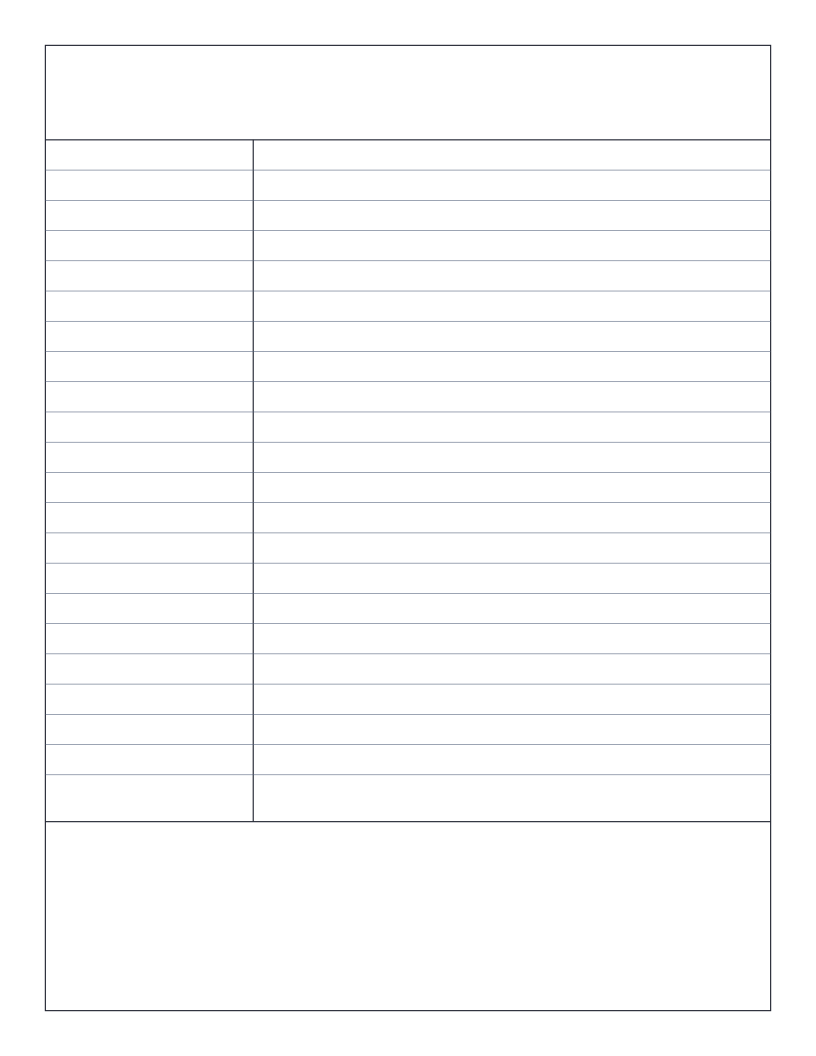
Cornell Notes Paper
The famous Cornell note-taking layout: cue column, main notes and summary band.
Lined Paper (College Ruled)
Classic college-ruled lined paper: 7.1mm line spacing with a red margin.
Wide Ruled Lined Paper
Classic wide-ruled lined paper: 8.7mm line spacing, the US elementary school standard.
Narrow Ruled Lined Paper
Narrow-ruled lined paper: 6.4mm line spacing, more text per page.