Live preview · Letter (8.5" × 11") · Gray lines
Cross-Stitch Pattern Paper
A fine 2.5 mm grid with heavier lines every ten cells, producing distinct 10×10 stitch blocks. The format every published cross-stitch pattern uses, because counting in tens is dramatically faster than counting in ones when a pattern spans hundreds of stitches.
Download generates a crisp vector PDF directly, no print dialog needed.
Choose a different paper size:
Choose a different line color:
Great for
- Charting original cross-stitch designs
- Adapting photos or images to needlepoint
- Transferring pattern symbols when adapting a published design
- Tapestry, needlepoint and beading projects on a square stitch grid
Cross-Stitch Pattern Paper at a glance
| What it is | Fine 2.5mm grid with heavier 10×10 block lines: the standard format for charting cross-stitch and needlepoint patterns. |
|---|---|
| Category | Specialty |
| Paper sizes | Letter (8.5" × 11"), A4 (210 × 297 mm), 11" × 17", Legal (8.5" × 14"), A3 (297 × 420 mm), A2 (420 × 594 mm), Poster (18" × 24"), Movie Poster (27" × 40") |
| Line colors | Faint, Light, Gray, Dark, Black, Blue, Green (default: Gray) |
| Format | Vector PDF download at exact physical scale, or print directly from the browser |
| Price & license | Free. No signup or watermark. Printed sheets may be used for personal, classroom and commercial work. |
About cross-stitch pattern paper
Cross-stitch is fundamentally a counted-thread technique. Every stitch occupies one square of the underlying fabric (Aida cloth, evenweave linen, plastic canvas), and the pattern is a map that tells you which colour goes in which square. The 10×10 block convention emerged in the early 20th century as the standard for printed pattern books: counting individual cells is slow and error-prone, but counting 10×10 blocks is fast and reliable. A pattern that's 80 stitches wide is eight blocks across — you measure it in one glance instead of counting eighty cells. The heavier lines also serve as visual anchors when you're transferring a count from chart to fabric; if you've stitched five blocks across and twelve down, you know exactly where you are without re-counting from the start. The 2.5 mm cell size is small enough that a 200×200 stitch pattern fits comfortably on a Letter or A4 page, large enough to write symbols inside each cell when colour-coding for stitching. Most published cross-stitch patterns use this exact density.
What's on the page
A 2.5 mm square grid covering the printable area, with every tenth line drawn heavier as a block divider. The page fits roughly 70×100 cells on Letter (175×250 mm useful area), or 75×110 cells on A4. The grid is centred so the margins split evenly. No labels or numbers — the convention is to write your own count along the edges if needed, or just rely on the 10-block divisions to keep track.
How to use it well
Count by blocks, not by cells
When you mark out a motif, work in units of ten. 'Start at column 30, row 50' is three blocks across, five blocks down — fast to locate. 'Start at column 27, row 53' takes longer and is easier to miscount.
Use symbols, not colours, for charting
Print a pattern in colour and the symbols are obvious. Print in black-and-white (which costs nothing and reproduces cleanly) and the colours disappear. Symbols (X, /, dot, square, etc.) survive both colour and grayscale and are the standard convention.
Mark the centre before you start stitching
Cross-stitchers traditionally start from the centre of the fabric and work outward, which keeps the pattern centred on the cloth regardless of how the edges are framed. Mark the chart's centre with a clear cross or symbol so you can find your starting point quickly.
Photocopy and write on the copy
Once you've drafted a chart, photocopy it before stitching. Mark off completed stitches on the copy as you go; preserve the original as a clean reference. Mistakes during marking are easier to recover from than mistakes on the original.
Common mistakes to avoid
- Confusing cell coordinates between chart and fabric. Cross-stitch fabric is counted in threads (stitches per inch); the chart is counted in cells. Both refer to the same stitch, but if you confuse 'this many cells on the chart' with 'this many inches on the fabric', the finished piece will be the wrong size.
- Using square graph paper without the 10-block accent. The cells alone aren't the problem — you can stitch from any grid — but counting is dramatically faster with the 10×10 block visual cue.
- Drawing diagonal lines through cells. Cross-stitch can't render arbitrary diagonals: each cell is either fully one colour or split into two triangular half-stitches (which the cell can show but the chart cannot represent on a single line). Draw with cell boundaries, not curves.
FAQ, Cross-Stitch Pattern Paper
What fabric count matches this paper?+
The paper itself doesn't have a count — you assign one. If you decide that one cell = one stitch on 14-count Aida, you'll know that 14 cells on the chart equals one inch on the fabric. For 18-count, 18 cells = 1 inch. The chart is unitless; the count comes from your fabric choice.
How is this different from [knitting chart paper](/graph-paper/knitting-chart-paper)?+
Cross-stitch cells are square (because cross-stitches are square). Knitting cells are rectangular (because knit stitches are wider than tall). The 10×10 block convention is similar but the cell shape differs. Using the wrong paper for the wrong craft distorts your design proportions.
Can I use this for needlepoint or tent stitch?+
Yes. Any counted technique with one stitch per square cell uses the same chart format. Needlepoint, petit point, plastic canvas, and bargello all share this format with cross-stitch.
What about half-stitches and three-quarter stitches?+
Charts represent these with split symbols or diagonal markings inside the cell. The grid doesn't constrain this; you draw the splits by hand. Most professional patterns use a standard symbol library (a half-filled triangle for half-stitches, a triangle pointing at the relevant corner for three-quarter stitches).
What size pattern fits on Letter / A4?+
About 70×100 cells on Letter (175 mm × 250 mm of usable area at 2.5 mm per cell), or 75×110 on A4. For larger patterns, print on tabloid (11×17 in) for ~110×165 cells, or tile a multi-page chart and tape the sheets together along the 10-block lines.
Printing tips for best results+
- 1. Click Print above. A new tab opens the template at exact size.
- 2. The print dialog appears automatically. Set Scale to 100%. Never "Fit to page", which silently shrinks every cell.
- 3. Set Margins to None or Minimum so the grid reaches the page edge.
- 4. For a PDF, click Download instead. It generates a vector PDF directly without going through the printer driver.
You might also like
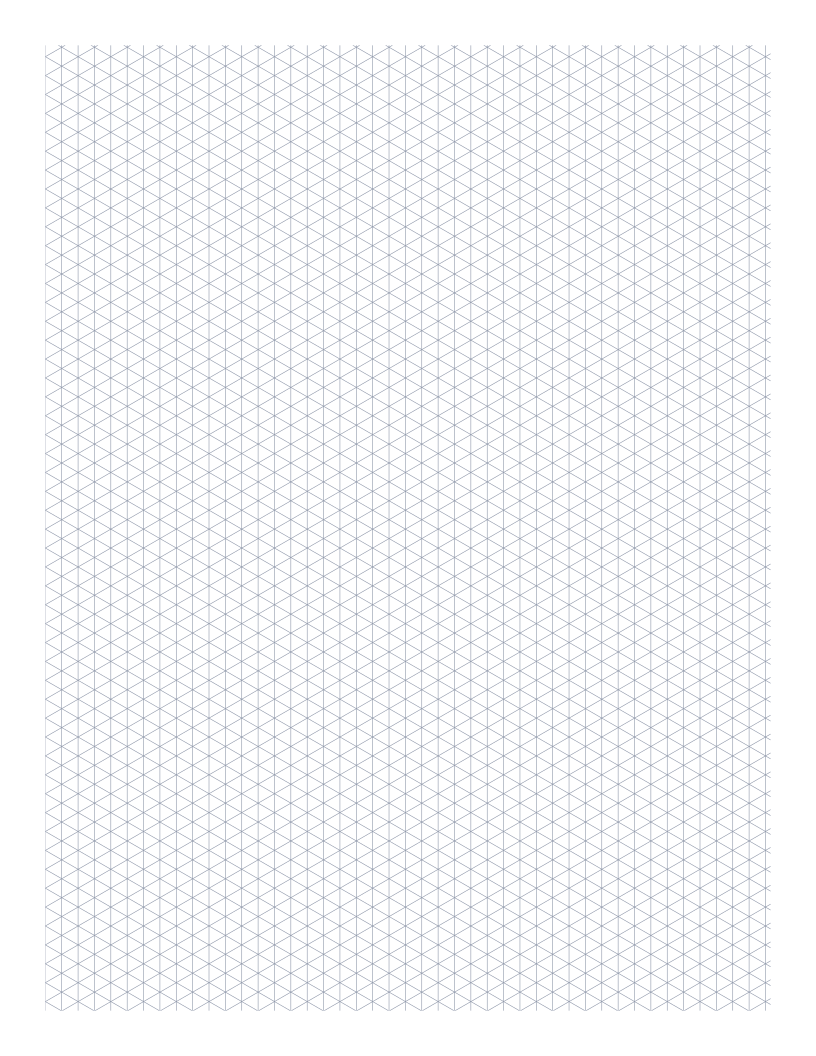
Isometric Graph Paper
Triangular 30°/60° grid for 3D drawings, technical sketches and Minecraft-style design.
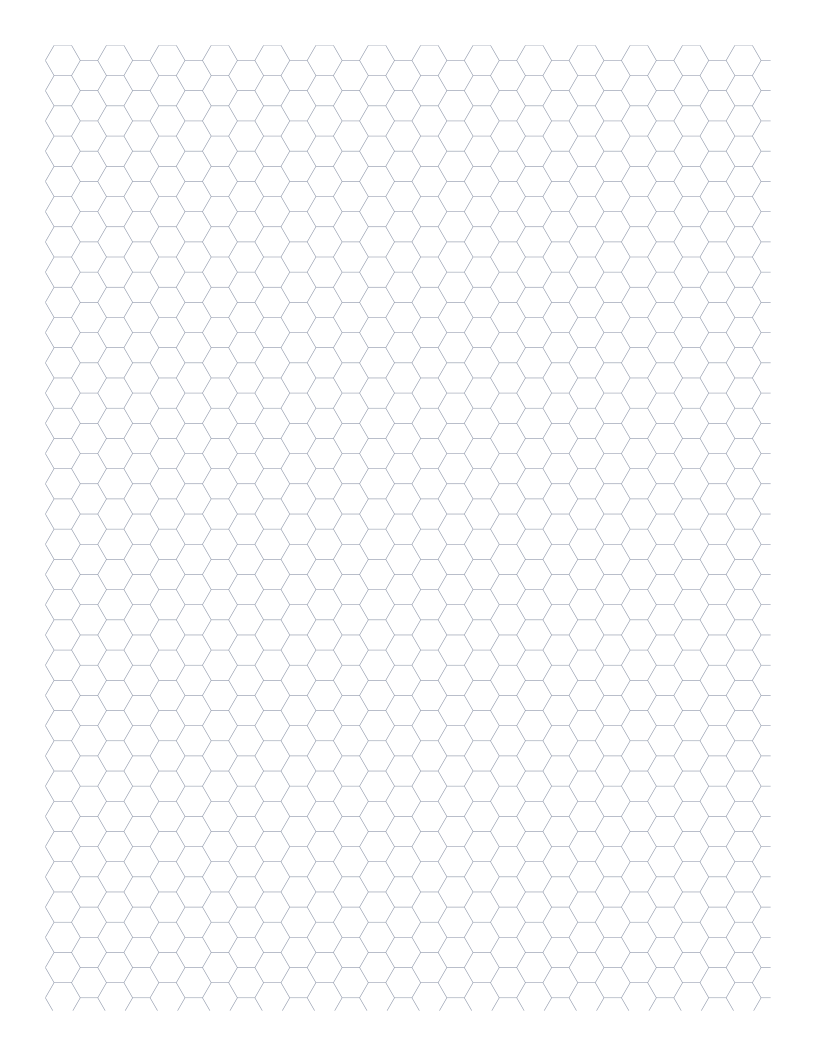
Hexagonal Graph Paper
Hexagonal tessellation: perfect for tabletop wargaming, organic chemistry and tile-based games.
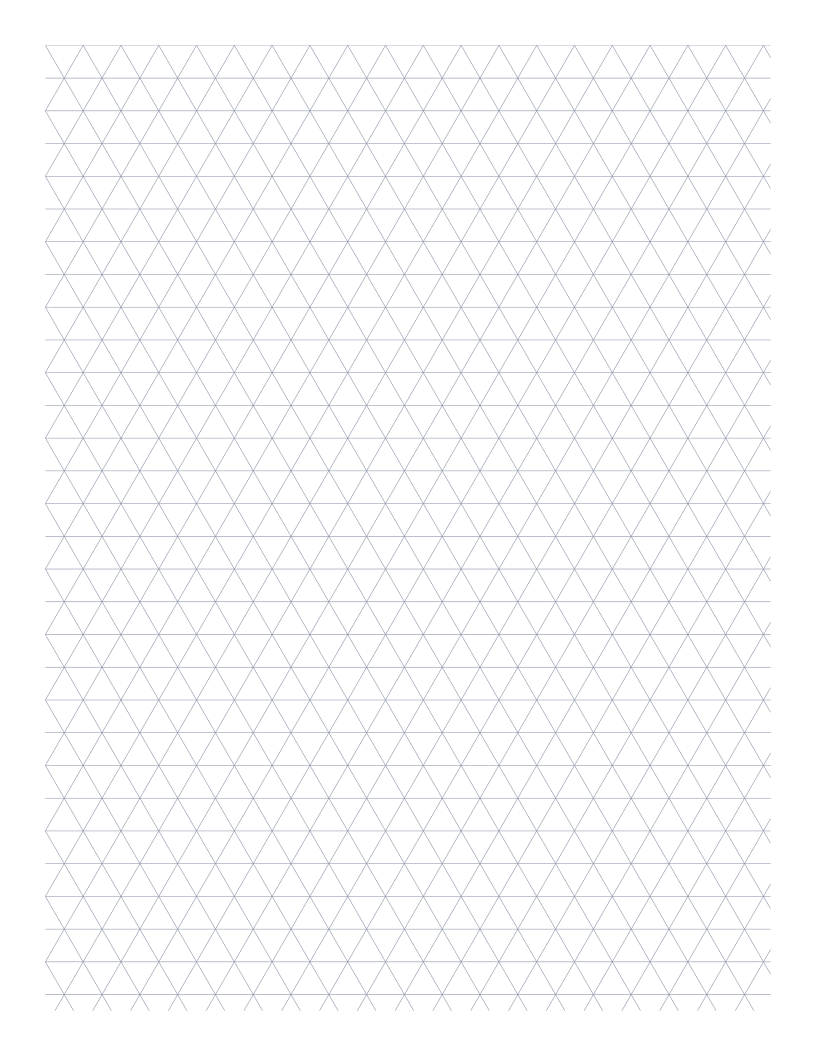
Triangular Graph Paper
Equilateral triangle grid: useful for ternary diagrams and tessellation art.
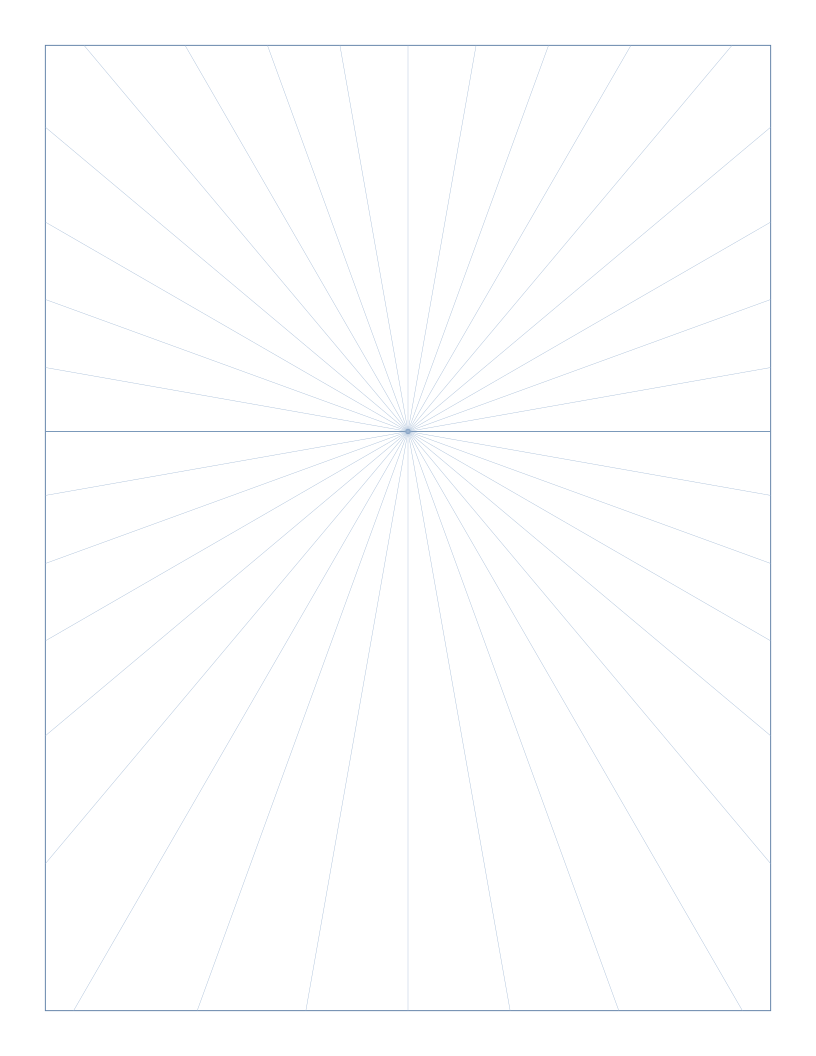
1-Point Perspective Grid
Single vanishing point on the horizon with radiating guides: the classic setup for hallways, rooms and street scenes.