Live preview · Letter Landscape (11" × 8.5") · Dark lines
Blank Periodic Table
A blank periodic table with all 118 element positions laid out in the standard 18-column format, including the lanthanide and actinide series below. Each cell is labelled with its atomic number; you fill in the symbol, name and any other properties for study or review. The page is sized landscape so the wide 18-column table uses the full width of the paper.
Download generates a crisp vector PDF directly, no print dialog needed.
Choose a different paper size:
Choose a different line color:
Great for
- Memorising element symbols and names (high school chemistry)
- Periodic-trend exercises (electronegativity, atomic radius, ionisation energy)
- Reference for organic and inorganic chemistry coursework
- Quick blank for tests and self-quizzing
Blank Periodic Table at a glance
| What it is | Blank periodic table with atomic numbers in each cell: fill in symbols, names and properties. Printed landscape so the 18-column table fills the page. |
|---|---|
| Category | Scientific |
| Paper sizes | Letter Landscape (11" × 8.5"), A4 Landscape (297 × 210 mm), Tabloid Landscape (17" × 11") |
| Line colors | Faint, Light, Gray, Dark, Black, Blue, Green (default: Dark) |
| Format | Vector PDF download at exact physical scale, or print directly from the browser |
| Price & license | Free. No signup or watermark. Printed sheets may be used for personal, classroom and commercial work. |
About blank periodic table
The periodic table is the single most important visual artifact in chemistry. Mendeleev's 1869 arrangement, refined by Moseley after the discovery of atomic number in 1913, organises the elements into rows (periods) and columns (groups) such that elements in the same column have similar chemical properties. The shape of the table — short period 1, short period 2 and 3, long periods 4–7, with a 'flap' for lanthanides and actinides — reflects the order in which electron orbitals fill: s-block on the far left, p-block on the right, d-block in the middle, f-block at the bottom. Every introductory chemistry student spends time staring at this layout, and the blank version is the principal study tool — you can't remember where 'molybdenum' goes if you've only ever seen filled tables. Filling in symbols, then names, then properties is the classical sequence; by the time a student can produce the full table from memory, the patterns of electron configuration and chemical similarity are usually internalised as well.
What's on the page
All 118 element cells in the standard 18-column × 7-period layout, with the 15 lanthanides (atomic numbers 57–71) and 15 actinides (89–103) shown as two extra rows below the main table. Each cell contains its atomic number in the upper-left corner and is otherwise blank — you fill in symbols, names, atomic masses or other properties. Dashed marker cells in the main table at positions (period 6, group 3) and (period 7, group 3) indicate where the lanthanide and actinide ranges insert into the main flow, labelled with the ranges 57–71 and 89–103.
How to use it well
Start with symbols, not names
Most students find element symbols easier to memorise than full names (and the symbols are what subsequent coursework actually uses). Fill in symbols first across the whole table; come back for full names as a separate pass.
Memorise by group, not by row
Group 1 (the alkali metals) and group 17 (the halogens) have strong chemical patterns that aid memorisation. Learning lithium, sodium, potassium together is easier than learning lithium, beryllium, boron — even though the second sequence is the row order.
Use colour to mark blocks
Lightly shade the s-block (groups 1–2 plus helium), p-block (groups 13–18), d-block (groups 3–12) and f-block (lanthanides and actinides) in different colours. The block structure is the underlying reason for the table's shape, and colour makes it immediate.
Check your transition-metal counts
The d-block spans 10 columns (groups 3–12), the f-block spans 14 columns. Many students miscount these, ending up with 9 or 11 columns of transition metals. Verify by counting the cells before starting any periodic-trend exercise.
Common mistakes to avoid
- Confusing period number with row number. The main table has 7 periods but the f-block appears as two extra rows below for layout reasons — the lanthanides are part of period 6, not period 8. Students who count rows visually sometimes treat the f-block as separate periods, which breaks every electron-configuration argument that depends on period number.
- Placing hydrogen wrong. Hydrogen is conventionally drawn in group 1, but it doesn't fit cleanly there (it's not an alkali metal). Some tables put it in both group 1 and group 17 (showing its dual character); some put it floating above. The location is a convention, not a fact about chemistry — don't take it as proof of group membership.
- Confusing atomic number with atomic mass. The number printed on each cell here is the atomic number (number of protons), which equals position in the table. Atomic mass is different (depends on isotope abundance) and usually printed separately on filled tables.
FAQ, Blank Periodic Table
Why are lanthanides and actinides shown below the main table?+
Pure layout convenience. Strictly, the lanthanides (57–71) belong in period 6 between groups 2 (Ba) and 4 (Hf), and the actinides (89–103) belong in period 7 between Ra and Rf. If they were drawn in those positions, the table would be 32 columns wide, which doesn't fit on a page. Pulling them out and showing them as two extra rows below is the universal convention for printed tables.
Why are some cells blank in my answer key?+
All 118 cells have a discovered element (atomic numbers 1 through 118), so a complete table has no blanks. If your textbook table has blanks, it likely predates the official naming of elements 113, 115, 117, 118 (nihonium, moscovium, tennessine, oganesson — named in 2016). The template here includes all 118.
What's the order of difficulty for memorising?+
Group 1 and group 17 are typically easiest (strong chemical pattern, fewer elements per row in the early rows). Groups 13–18 in periods 2 and 3 are next. The d-block (transition metals) is harder because the pattern is less obvious to a beginner. The f-block is hardest and rarely memorised in detail by introductory students — knowing it exists is usually enough.
Do I need to memorise all the elements?+
Depends on curriculum. High school chemistry typically covers the first 20 elements in detail, with passing familiarity for the first 36 or so. AP and IB chemistry expect more. Organic chemistry uses mostly H, C, N, O, F, P, S, Cl, Br, I — and a chemistry major eventually knows every element by symbol and approximate position. The blank table is a tool for whichever level you're at.
What's the atomic number in the corner for?+
Identification. With every cell labelled by atomic number, you can fill in any subset (e.g., 'just the first 30 elements') without ambiguity about which cell corresponds to which element. Without the number, an empty table can be confusing when you've only filled in a few cells.
Printing tips for best results+
- 1. Click Print above. A new tab opens the template at exact size.
- 2. The print dialog appears automatically. Set Scale to 100%. Never "Fit to page", which silently shrinks every cell.
- 3. Set Margins to None or Minimum so the grid reaches the page edge.
- 4. For a PDF, click Download instead. It generates a vector PDF directly without going through the printer driver.
You might also like
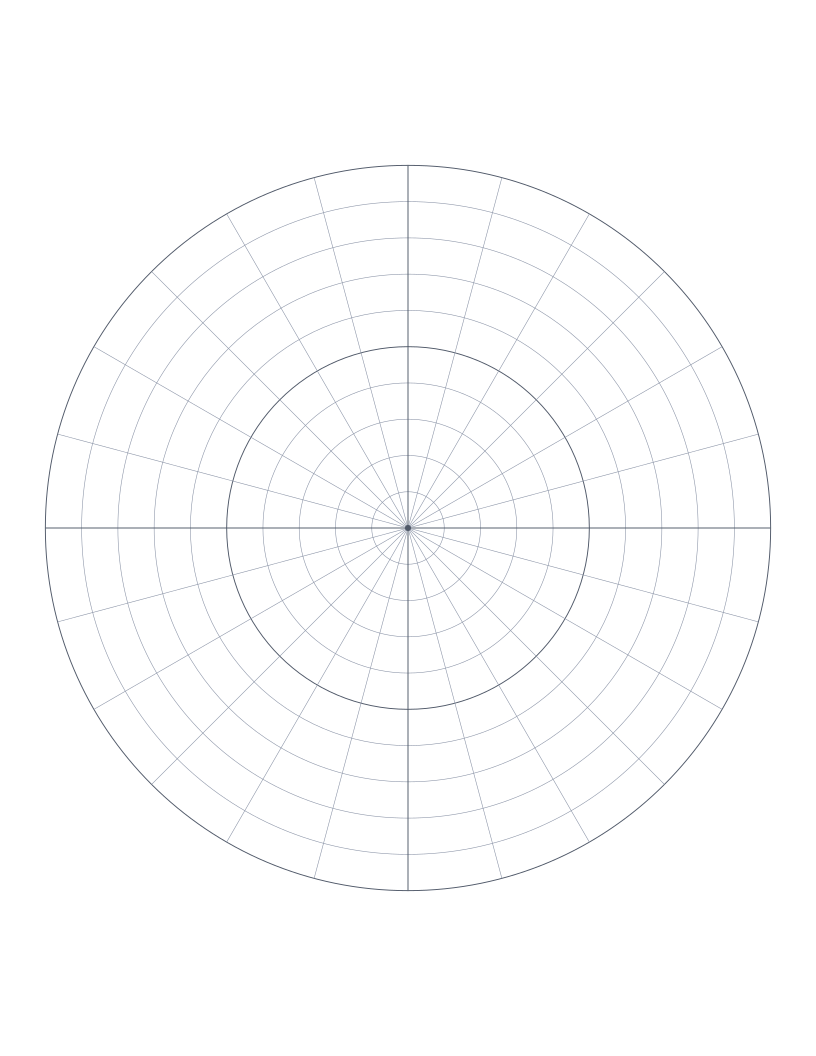
Polar Graph Paper
Concentric circles with radial spokes: for polar coordinates, vector diagrams and circular design.
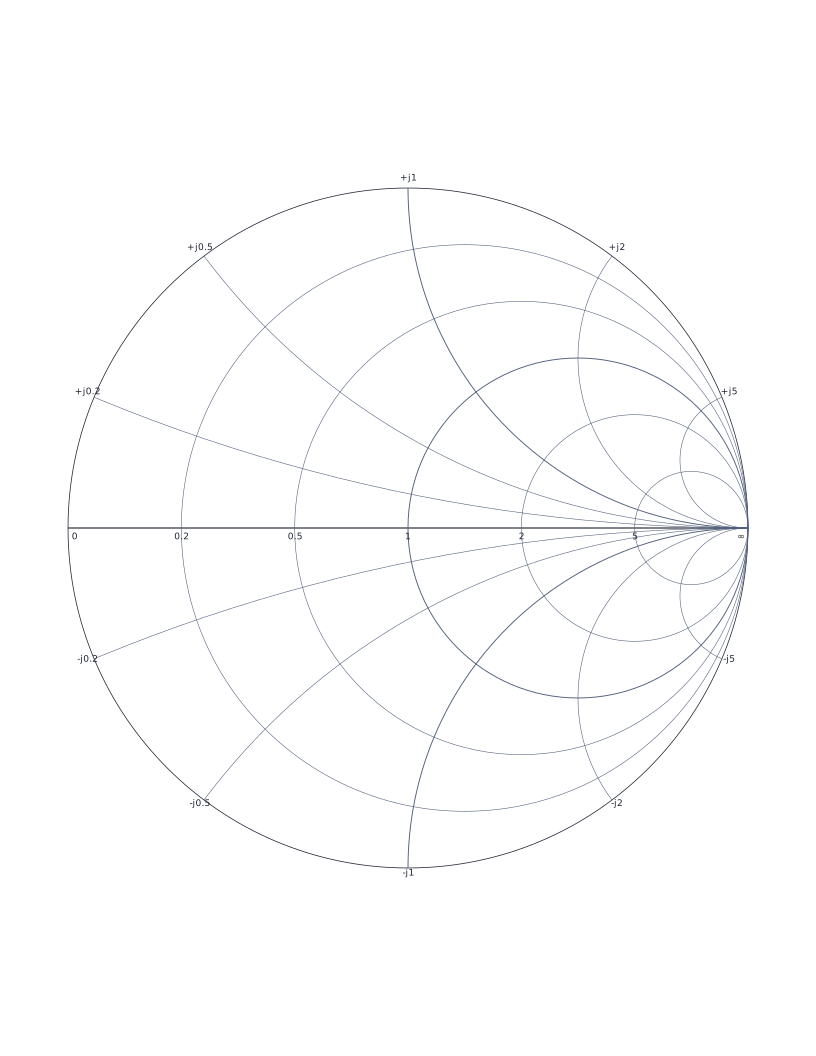
Smith Chart
Classic Smith chart for transmission line impedance matching and RF engineering.
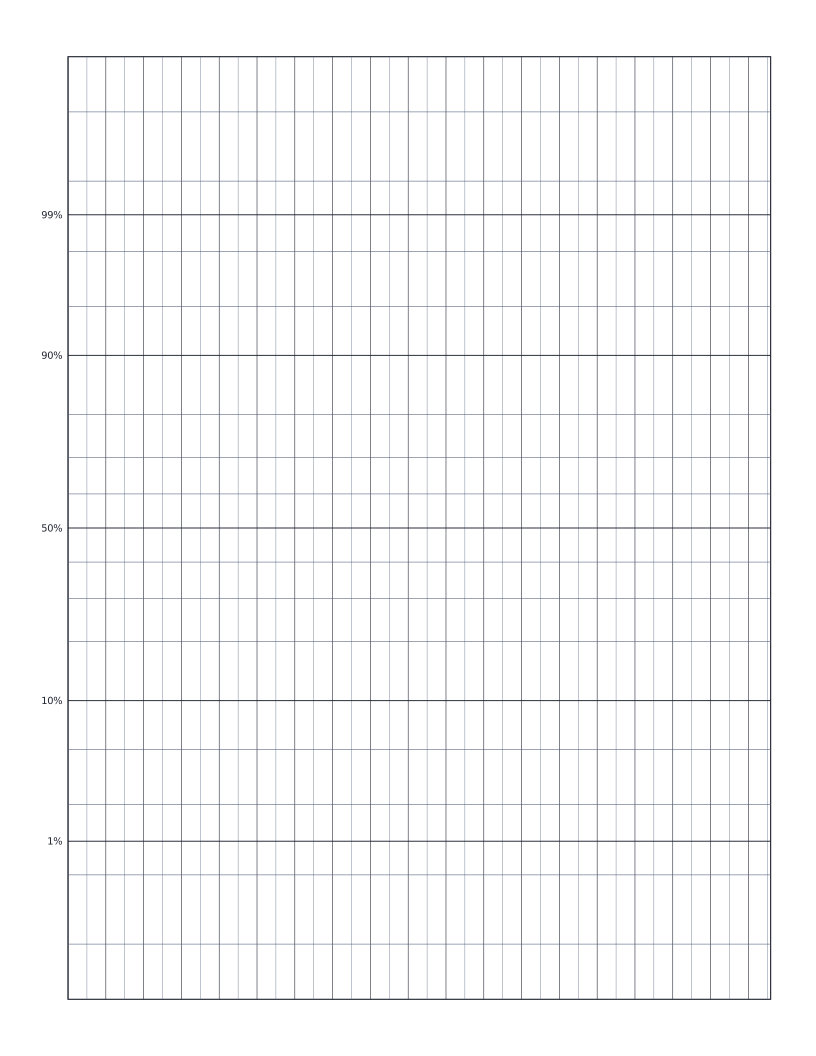
Normal Probability Paper
Normal probability paper: y-axis scaled by inverse normal CDF for plotting distribution data.
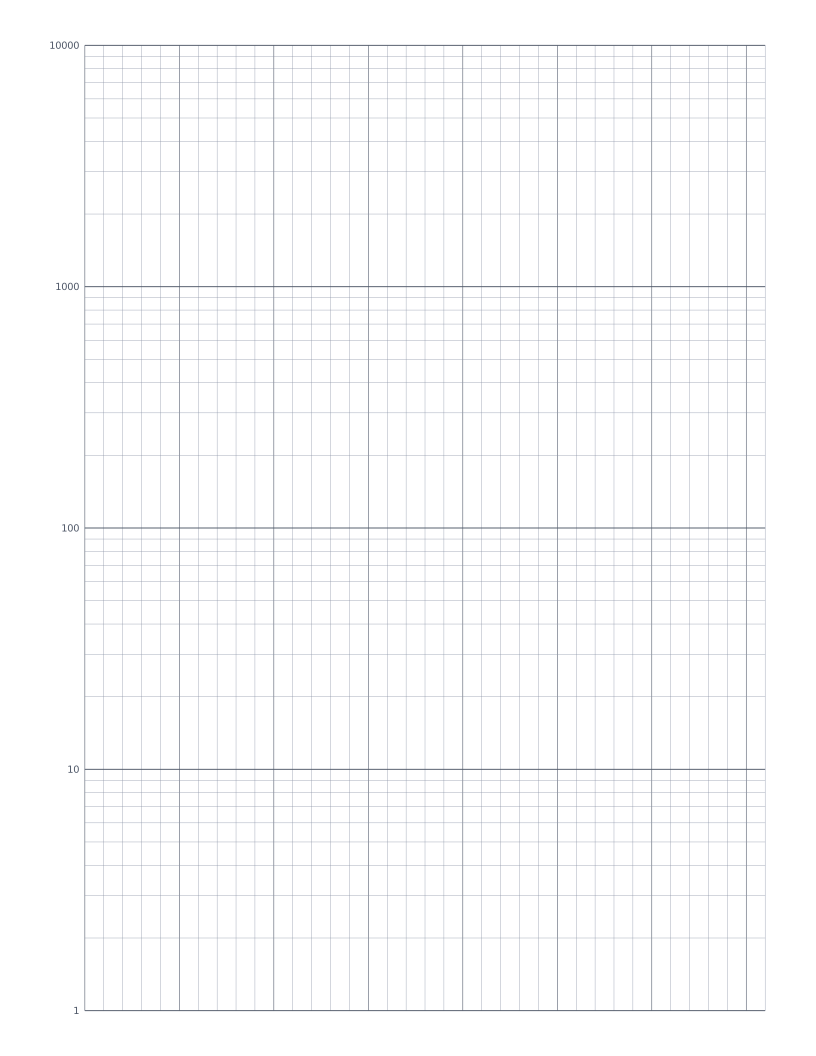
Semi-Log Graph Paper
Linear x-axis with a 4-decade logarithmic y-axis: the standard sheet for plotting exponentials and decay curves.