Live preview · Letter (8.5" × 11") · Gray lines
Hundreds Chart
The hundreds chart arranges the integers 1 to 100 in a 10×10 grid, with each row holding ten consecutive numbers and each column holding numbers that differ by ten. The structure makes arithmetic patterns visible. Multiples of 5 form columns, multiples of 11 form a diagonal, and the place-value relationship between rows and columns becomes immediate.
Download generates a crisp vector PDF directly, no print dialog needed.
Choose a different paper size:
Choose a different line color:
Great for
- Skip-counting by 2s, 5s, 10s and other small numbers
- Discovering multiplication and division patterns
- Place-value practice and tens / ones decomposition
- Number sense games (highlighter games, missing numbers)
Hundreds Chart at a glance
| What it is | 10×10 grid numbered 1 to 100: a classroom staple for counting, place value and skip-counting. |
|---|---|
| Category | Math & Learning |
| Paper sizes | Letter (8.5" × 11"), A4 (210 × 297 mm), 11" × 17", Legal (8.5" × 14"), A3 (297 × 420 mm), A2 (420 × 594 mm), Poster (18" × 24"), Movie Poster (27" × 40") |
| Line colors | Faint, Light, Gray, Dark, Black, Blue, Green (default: Gray) |
| Format | Vector PDF download at exact physical scale, or print directly from the browser |
| Price & license | Free. No signup or watermark. Printed sheets may be used for personal, classroom and commercial work. |
About hundreds chart
The hundreds chart is the dominant elementary-math visual aid for the first three years of school. The format is older than American math education, showing up in 19th-century European primers and likely earlier, but it became universal in US classrooms after the 1960s New Math reforms emphasised pattern recognition as a foundation for arithmetic understanding. The grid does one job: it makes the structure of the base-10 number system visible. The fact that 23 is just above 33 isn't a coincidence: every column step adds ten, every row step adds one. Children who use the chart enough internalise this without ever being told it explicitly. Skip-counting patterns become geometry: the 5s are two columns, the 10s are one column, the 11s climb a diagonal. The chart's longevity comes from how much information it carries in one image without requiring the child to manipulate any of it actively.
What's on the page
A 10×10 grid of 100 cells, each labelled with the corresponding integer from 1 to 100. Cell sizes are large enough that students can write or highlight inside each one. The grid is centred on the page with comfortable margins for instructions or annotation. Row 1 holds 1–10, row 2 holds 11–20, and so on, with row 10 holding 91–100. The standard convention is that 1 is the upper-left cell and 100 is the lower-right.
How to use it well
Highlight skip-counting patterns
Have students highlight all multiples of 2 (every other cell. Produces a checkerboard pattern), then 5 (two full columns), then 10 (one full column). The visual patterns are the lesson, multiplication tables aren't arbitrary, they're geometric.
Use it for place value
Ask 'what's 10 more than 27?', the answer is one row down (37). 'What's 10 less than 43?', one row up (33). Add 1 by moving right; subtract 1 by moving left. This makes the +/- 10 versus +/- 1 distinction concrete in a way that pure arithmetic doesn't.
Play 'missing number' games
Cover a small section of the chart with sticky notes and ask students to write the missing numbers based on the surrounding ones. The patterns make the answers deducible without arithmetic, building number sense rather than calculation skill.
Try a 0-99 variant for tens-pattern work
Some teachers prefer 0–99 starting in the upper-left, which puts each multiple of 10 at the start of a row (0, 10, 20...) rather than at the end. The pedagogical merits are debated; the 1-100 version is more traditional. Add a row of cells above for 0 if you want both representations.
Common mistakes to avoid
- Treating the chart as a calculation tool. The hundreds chart isn't a substitute for arithmetic practice, it's a pattern-recognition tool. Children who use it as a crutch for every calculation never develop computational fluency. Use it for noticing patterns, then drop back to arithmetic practice without it.
- Skipping the 'why' of patterns. When a student notices that the 9s form a downward diagonal (9, 18, 27, 36...), don't just confirm, ask why. The pattern exists because each step is +10 (move down) and -1 (move left), netting +9. Students who understand the why generalise; students who only memorise the pattern don't.
- Photocopying without checking cell labels. Office copy machines occasionally render small numbers (especially the early single-digit row) faintly. For paper that will be photocopied, choose Dark or Black line colour at the source.
FAQ, Hundreds Chart
How is the hundreds chart different from a multiplication table?+
The hundreds chart shows the integers 1 to 100 arranged sequentially in a 10×10 grid (left-to-right, top-to-bottom). A multiplication table shows products in a grid indexed by row and column (cell at row 4, column 7 = 28). They look similar but contain different information. The hundreds chart contains every number once; the multiplication table contains many numbers multiple times.
Why does 1 start in the upper-left and 100 end at the lower-right?+
Convention only, English reading order. Some teachers prefer the opposite orientation (100 at top, 1 at bottom) because it puts larger numbers higher, matching the intuitive 'numbers go up'. Both are used; the upper-left start is more traditional in the US.
Should I use a 1-100 or 0-99 chart?+
Both are defensible. 1-100 is the traditional convention and matches counting from 1. 0-99 puts the multiples of 10 at the start of each row (0, 10, 20...) and includes zero, which some teachers prefer for place-value work. Pick whichever matches your curriculum and stay consistent across the year.
What skip-counting patterns should I show?+
Start with 2s (every other number, checkerboard), then 5s (two columns), then 10s (one column). Move to 11s (diagonal pattern going down-and-right), 9s (diagonal going down-and-left), and 25s (every fourth cell going down). The patterns become harder as the skip number grows; that progression is itself a teaching tool.
What's a 'magic 9 trick'?+
Multiples of 9 (9, 18, 27, 36, 45...) sit on a downward-left diagonal because each step is +10 -1 = +9. The two digits of every multiple sum to 9 (1+8=9, 2+7=9, 3+6=9...). Students notice this on the chart and ask why. That's a productive 'why' conversation about how place value and arithmetic interact.
Can I use it for fractions or larger numbers?+
The standard hundreds chart only covers 1–100, which limits it. For fractions, a number line is better. For numbers above 100, you can stack hundreds charts (rows 101–200, 201–300) but the format starts losing the visual punch. Past about 300, you're better off with a different representation.
Printing tips for best results+
- 1. Click Print above. A new tab opens the template at exact size.
- 2. The print dialog appears automatically. Set Scale to 100%. Never "Fit to page", which silently shrinks every cell.
- 3. Set Margins to None or Minimum so the grid reaches the page edge.
- 4. For a PDF, click Download instead. It generates a vector PDF directly without going through the printer driver.
You might also like
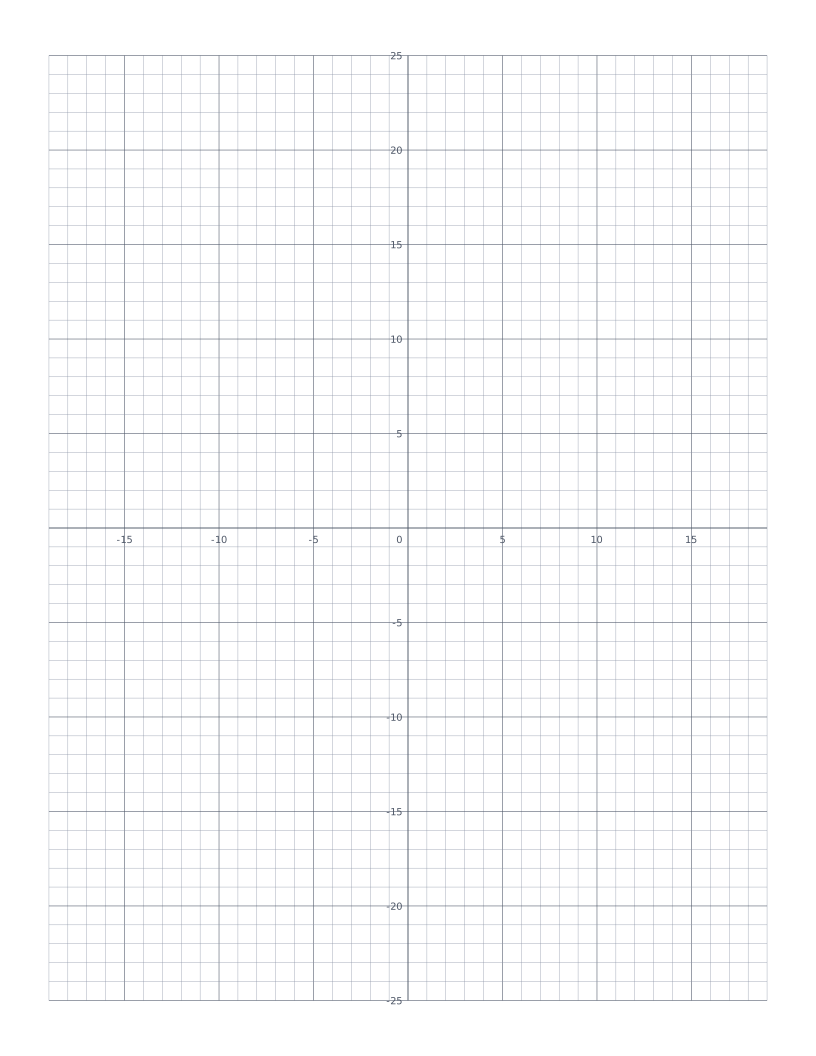
Coordinate Plane
Cartesian grid with numbered x and y axes through the centre: four quadrants for plotting points and graphing functions.
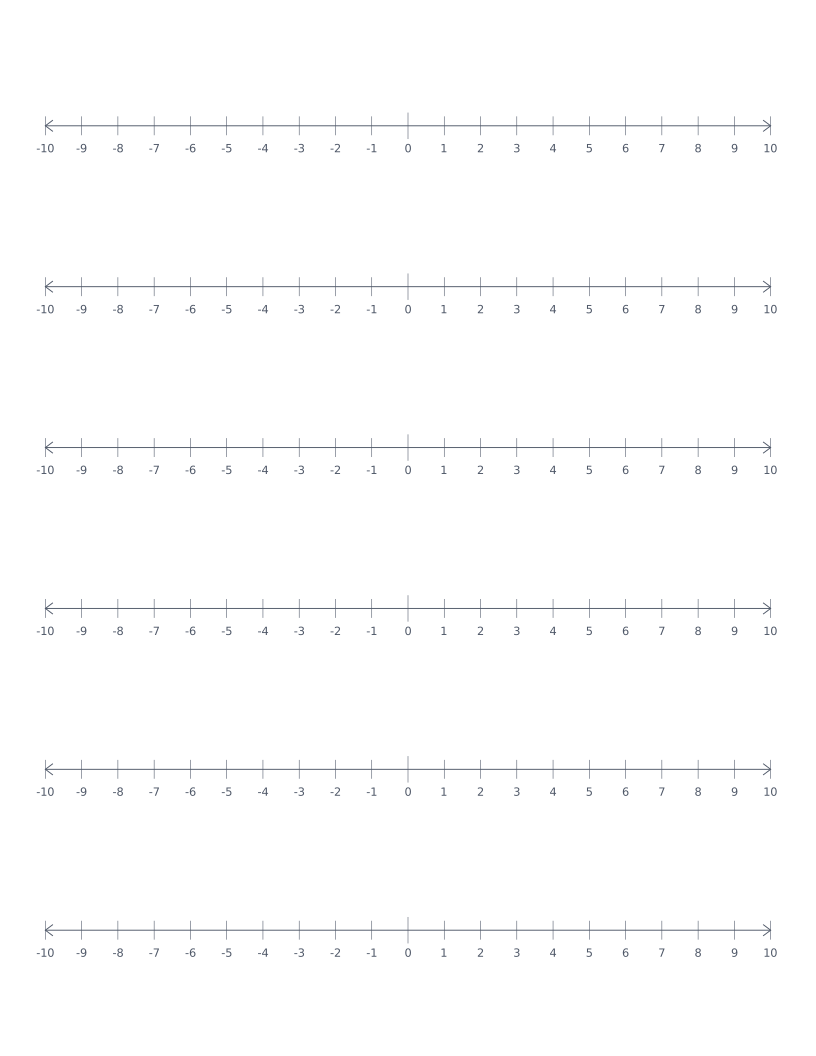
Number Line
Stacked number lines from -10 to 10: for elementary math, addition, subtraction and integer practice.
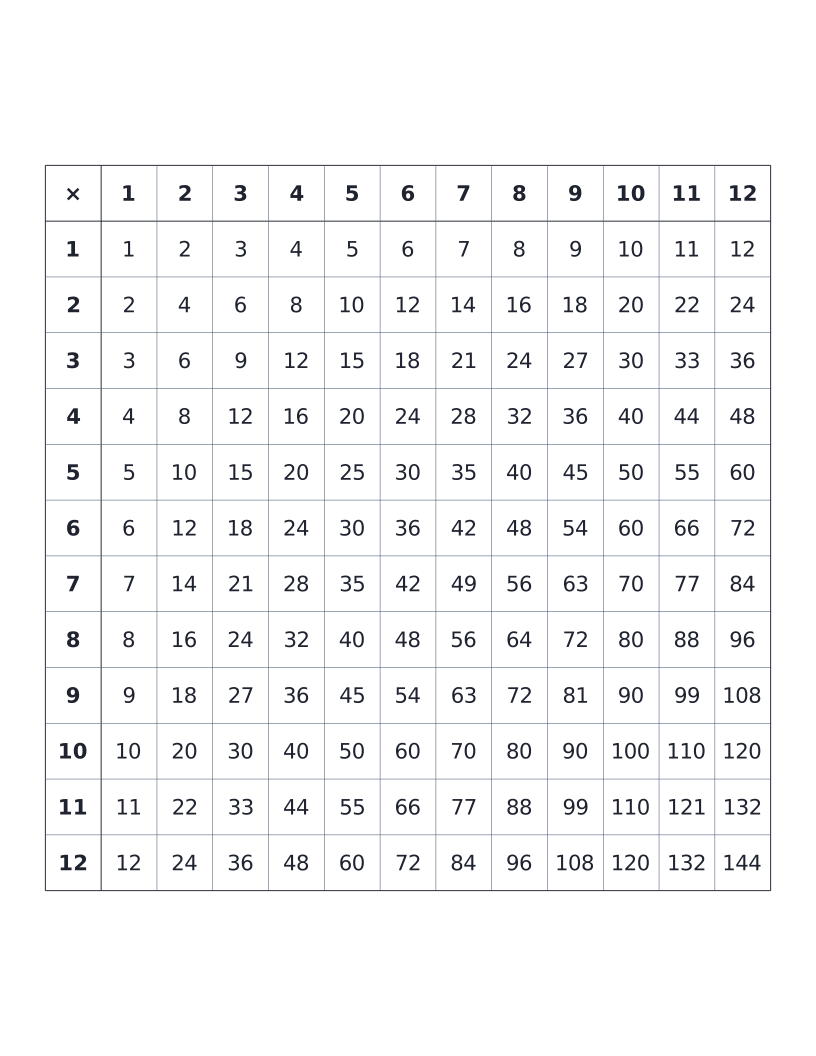
Multiplication Table (12×12)
12×12 times table with all products printed: the classic elementary reference chart.
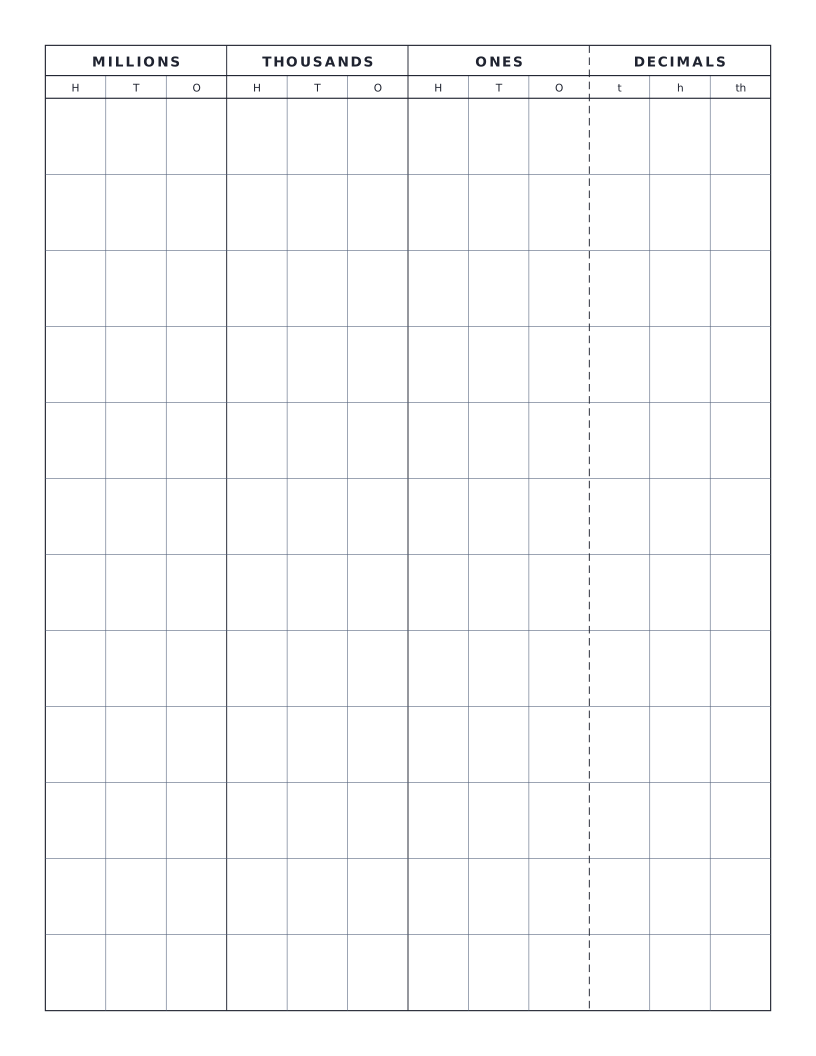
Place Value Chart
Standard place value chart through millions with optional decimals: groups columns by period (ones, thousands, millions) for clear reading.